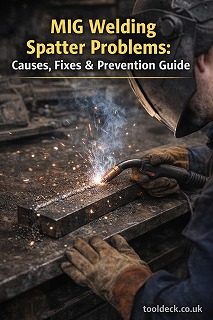
MIG welding spatter is a common issue that affects both beginners and experienced welders. Those small molten droplets that scatter around your weld not only make your work look messy but also increase clean-up time and reduce efficiency.
While some spatter is normal, excessive spatter usually indicates a problem with your setup or technique.
In this guide, we’ll explain why MIG welding spatter occurs, how to fix it, and how to achieve cleaner, more professional welds.
What Is MIG Welding Spatter?
Spatter refers to small droplets of molten metal that are expelled from the welding arc and stick to the surrounding surface.
Common signs include:
- Metal splashes around the weld area
- Rough, uneven weld appearance
- Increased post-weld clean-up
- Reduced overall weld quality
Main Causes of MIG Welding Spatter
1. Incorrect Voltage Settings
Voltage that is too high or too low can destabilise the arc.
- Too high → excessive spatter and heat
- Too low → irregular arc and poor transfer
👉 Fix:
Adjust voltage according to material thickness and test until the arc is smooth.
2. Improper Wire Feed Speed
Wire feed speed must match voltage:
- Too fast → wire “pushes” into the weld pool, causing spatter
- Too slow → unstable arc
👉 Fix:
Fine-tune wire feed speed until you achieve a steady, consistent arc.
3. Poor Shielding Gas Coverage
Inadequate shielding gas allows air to contaminate the weld pool.
👉 Fix:
- Set gas flow rate between 10–20 L/min
- Check for leaks in hoses and regulators
- Avoid welding in windy conditions
4. Wrong Gas Mixture
Using pure CO₂ can increase spatter compared to mixed gases.
👉 Fix:
Use an Argon/CO₂ mix (e.g. 75/25) for cleaner welds and reduced spatter.
5. Dirty or Contaminated Metal
Rust, paint, or oil can cause unstable arcs and more spatter.
👉 Fix:
- Clean the workpiece thoroughly
- Use a grinder or wire brush before welding
6. Incorrect Polarity
Using the wrong polarity can severely affect arc stability.
👉 Fix:
Ensure your MIG welder is set to DCEP (Direct Current Electrode Positive) for solid wire.
7. Poor Technique
Inconsistent movement or incorrect torch angle can create spatter.
👉 Fix:
- Maintain a steady hand
- Keep a consistent travel speed
- Use a torch angle of around 10–15 degrees
8. Long Arc Length (Incorrect Stick-Out)
Too much distance between the tip and workpiece leads to an unstable arc.
👉 Fix:
Keep stick-out within 10–15 mm.
How to Reduce MIG Welding Spatter (Step-by-Step)
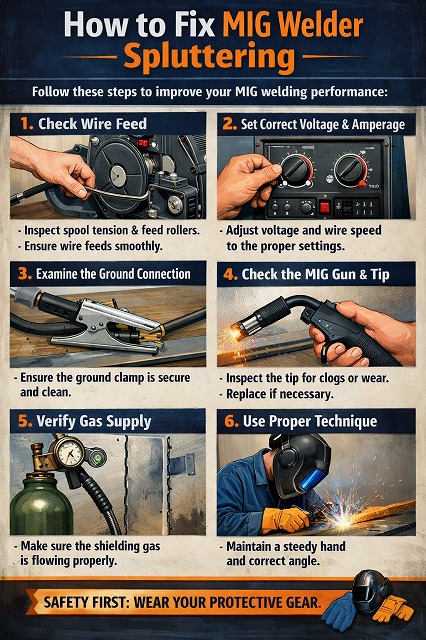
Step 1: Optimise Settings
Balance voltage and wire feed speed.
Step 2: Check Gas Flow
Ensure proper shielding gas coverage.
Step 3: Clean the Surface
Remove all contaminants before welding.
Step 4: Inspect Equipment
Check contact tip, liner, and wire condition.
Step 5: Improve Technique
Maintain consistent movement and correct angles.
Pro Tips for Cleaner MIG Welds
- ✔ Use high-quality welding wire
- ✔ Keep your equipment well maintained
- ✔ Use anti-spatter spray for easier clean-up
- ✔ Practise consistent welding technique
- ✔ Avoid welding in windy environments
Quick Troubleshooting Checklist
- Voltage set correctly?
- Wire feed speed balanced?
- Shielding gas adequate?
- Correct gas mixture used?
- Metal clean and prepared?
- Polarity correct?
- Stick-out maintained?
- Technique consistent?
FAQs
Is spatter normal in MIG welding?
Yes, a small amount is normal, but excessive spatter indicates a problem with settings or technique.
What gas reduces spatter in MIG welding?
An Argon/CO₂ mix (such as 75/25) significantly reduces spatter compared to pure CO₂.
Can voltage cause spatter?
Yes. Incorrect voltage is one of the main causes of excessive spatter.
How do I get smoother MIG welds?
Use proper settings, clean materials, correct gas, and maintain consistent technique.
Conclusion
MIG welding spatter problems are usually caused by incorrect settings, poor gas coverage, or inconsistent technique. The good news is that these issues are easy to fix with a few adjustments.
By optimising your setup and refining your welding technique, you can achieve cleaner welds, less spatter, and a more professional finish.

Leave a Reply