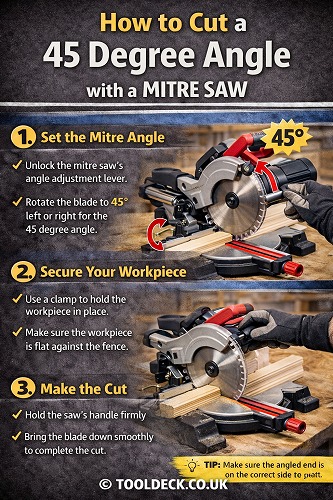
Cutting a 45 degree angle is one of the most common and important skills in woodworking. Whether you’re installing skirting boards, making picture frames, or fitting architraves, mastering how to cut a 45 degree angle with a mitre saw ensures clean, professional results.
In this UK-focused guide, you’ll learn the exact steps, tips, and mistakes to avoid for perfect 45° cuts every time.
What Is a 45 Degree Cut?
A 45° cut is an angled cut used to join two pieces at a perfect corner—typically forming a 90° joint.
👉 Common uses in the UK:
- Skirting boards
- Picture frames
- Door architraves
- Trim and moulding
Tools You’ll Need
Before starting:
- Mitre saw (any standard model)
- Measuring tape
- Pencil
- Clamp (recommended)
- Safety gear (goggles, ear protection)
Step-by-Step: How to Cut a 45 Degree Angle
Step 1: Measure and Mark
- Measure your material carefully
- Mark the cut line clearly
💡 Tip: Always mark the waste side to avoid mistakes.
Step 2: Set the Mitre Angle to 45°
- Unlock the mitre adjustment
- Rotate the saw to 45° (left or right)
- Lock it firmly in place
👉 Most mitre saws have preset stops at 45° for quick setup.
Step 3: Position the Material
- Place the material flat against the fence
- Align the blade with your mark
- Clamp if necessary
Step 4: Make the Cut
- Start the saw and let it reach full speed
- Lower the blade slowly and smoothly
- Do NOT force the cut
Step 5: Check the Fit
- Join the cut pieces together
- Ensure a tight 90° corner
- Adjust if needed
Left vs Right 45° Cuts (Very Important)
This is where many beginners make mistakes.
Left 45° Cut:
- Used for one side of a corner
Right 45° Cut:
- Used for the opposite side
👉 Always visualise how pieces will join before cutting.
Common 45° Applications
Internal Corners
- Skirting boards
- Typically two 45° cuts
External Corners
- Edges that stick out
- Also require mirrored 45° cuts
Picture Frames
- Four perfect 45° cuts
- Precision is critical
Tips for Perfect 45° Cuts
✔ Use a Sharp Blade
Ensures clean edges with no splintering.
✔ Test on Scrap Material
Avoid wasting expensive wood.
✔ Keep Material Stable
Movement = inaccurate cuts.
✔ Use a Stop Block
Great for repeat cuts.
Common Mistakes to Avoid
❌ Cutting the Wrong Direction
Always double-check left vs right angle.
❌ Not Locking the Angle
Loose settings lead to inaccurate cuts.
❌ Rushing the Cut
Slow, controlled cuts give better results.
❌ Poor Measurement
Even perfect cuts won’t fit if measurements are wrong.
UK-Specific Tips
- Walls in UK homes are not always perfectly square → slight adjustments may be needed
- MDF is commonly used → use a fine-tooth blade for clean cuts
- Use decorator’s caulk to hide small gaps
Quick 45° Cheat Sheet
| Task | Angle Setting |
|---|---|
| Internal corner | 45° |
| External corner | 45° |
| Picture frame | 45° (all sides) |
❓ FAQs: Cutting a 45 Degree Angle
How do you cut a perfect 45 degree angle?
Set your mitre saw to 45°, secure the material, and cut slowly. Always test on scrap wood before making final cuts.
Which way do I cut a 45 degree angle?
It depends on the joint. You’ll need left and right 45° cuts for corners—always visualise how the pieces will fit together.
Why don’t my 45 degree cuts line up?
This is usually due to incorrect angle settings, poor measurement, or the saw being out of calibration.
Can I cut a 45 degree angle without a mitre saw?
Yes, using a mitre box and hand saw, but accuracy is lower compared to a mitre saw.
Do I need a bevel for a 45 degree cut?
No, a standard 45° cut is a mitre cut. Bevel is only needed for angled cuts through thickness.
What is the most common use for a 45 degree cut?
It’s most commonly used for skirting boards, frames, and trim work in UK homes.
Final Thoughts
Learning how to cut a 45 degree angle with a mitre saw is a fundamental skill that unlocks a wide range of DIY and professional projects. With the right setup and technique, you can achieve clean, accurate joints every time.
👉 Key takeaway:
- Set angle correctly
- Understand left vs right cuts
- Always test before final cuts




Leave a Reply