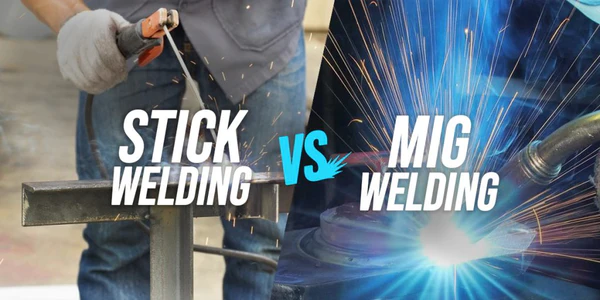
If you’re getting into welding, you’ve probably come across the debate: MIG vs Stick welding – which one should you choose? Both methods are widely used across the UK for DIY, construction, and industrial work, but they serve very different purposes.
In this complete guide, you’ll learn the key differences between MIG and Stick welding, including pros, cons, costs, and when to use each method.
Contents
What is MIG Welding?
MIG (Metal Inert Gas) welding uses a continuous wire feed and shielding gas to create clean welds.
Key Features:
- Easy to learn
- Fast welding speed
- Requires shielding gas
- Produces clean welds with minimal slag
👉 MIG is ideal for beginners and indoor welding projects.
What is Stick Welding?
Stick welding (also known as MMA – Manual Metal Arc welding) uses a consumable electrode rod coated in flux.
Key Features:
- No external gas required
- Works well outdoors
- Strong, durable welds
- More tolerant of dirty materials
👉 Stick welding is commonly used in construction and heavy-duty work
MIG vs Stick Welding: Key Differences
1. Ease of Use
- MIG Welding: Very beginner-friendly
- Stick Welding: Harder to learn and control
👉 Winner: MIG
2. Welding Speed
- MIG: Fast and efficient
- Stick: Slower (frequent electrode changes)
👉 Winner: MIG
3. Weld Quality
- MIG: Cleaner welds, less spatter
- Stick: Strong but rougher finish with slag
👉 Winner:
- Clean finish → MIG
- Strength → Stick
4. Outdoor vs Indoor Use
- MIG: Best indoors (gas affected by wind)
- Stick: Excellent outdoors (no gas needed)
👉 Winner: Stick
5. Material Condition
- MIG: Requires clean metal
- Stick: Works on rusty or dirty surfaces
👉 Winner: Stick
6. Equipment Cost (UK)
- MIG Welders: More expensive (gas + machine)
- Stick Welders: Cheaper and simpler
👉 Winner: Stick
7. Portability
- MIG: Less portable (gas cylinder required)
- Stick: Highly portable
👉 Winner: Stick
Pros and Cons
MIG Welding Pros
- Easy for beginners
- Fast welding speed
- Clean welds with less spatter
- Ideal for thin to medium metals
MIG Welding Cons
- Requires shielding gas
- Not suitable for outdoor use
- Needs clean materials
Stick Welding Pros
- Works in windy conditions
- No gas required
- Handles dirty or rusty metal
- Low cost and portable
Stick Welding Cons
- Harder to learn
- More spatter and slag
- Slower process
- Less precise
When Should You Use MIG Welding?
Choose MIG if you:
- Are a beginner
- Work indoors (garage or workshop)
- Need clean, neat welds
- Work with thin or medium steel
- Do DIY or automotive repairs
👉 MIG is perfect for home users and hobbyists in the UK.
When Should You Use Stick Welding?
Choose Stick if you:
- Work outdoors
- Weld thick steel
- Need strong structural welds
- Work on rusty or dirty metal
- Want a low-cost setup
👉 Stick is ideal for construction, farm work, and heavy-duty jobs.
MIG vs Stick for Beginners
If you’re just starting out:
👉 MIG welding is the better choice
Why?
- Easier to learn
- Cleaner results
- Faster progress
However, if you plan to work outdoors or on rough materials:
👉 Stick welding may be more practical.
MIG vs Stick for Thin Metal
- MIG: Excellent control → best choice
- Stick: Difficult → risk of burn-through
👉 Winner: MIG
MIG vs Stick for Thick Metal
- MIG: Good but requires higher power
- Stick: Excellent penetration
👉 Winner: Stick
Final Verdict: MIG vs Stick Welding
Both methods have their place, and the best choice depends on your needs:
- Choose MIG welding for ease, speed, and clean results
- Choose Stick welding for strength, outdoor work, and low cost
👉 Many welders in the UK use both, depending on the job.
Leave a Reply