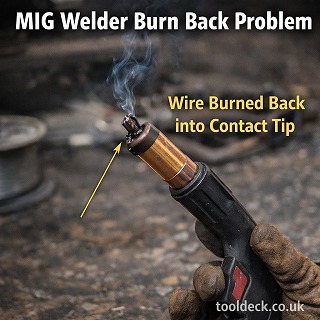
The MIG welder burn back problem is one of the most frustrating issues welders face. It occurs when the welding wire melts back into the contact tip, stopping the arc and disrupting your work.
Not only does burn back slow you down, but it can also damage your equipment and reduce weld quality.
In this guide, we’ll explain what causes burn back in MIG welding, how to fix it quickly, and what you can do to prevent it from happening again.
Contents
What Is Burn Back in MIG Welding?
Burn back happens when the welding wire burns faster than it feeds, causing it to fuse into the contact tip.
Common signs include:
- Wire stuck in the tip
- Sudden arc stoppage
- Popping or irregular arc
- Damaged or blocked contact tip
Main Causes of MIG Welder Burn Back
1. Wire Feed Speed Too Low
This is the most common cause.
If the wire isn’t feeding fast enough, it melts before reaching the weld pool.
👉 Fix:
- Increase the wire feed speed gradually
- Match it properly with your voltage settings
2. Voltage Too High
Excessive voltage generates too much heat, causing the wire to melt too quickly.
👉 Fix:
- Reduce voltage slightly
- Test and adjust until the arc stabilises
3. Incorrect Stick-Out (Tip Distance)
If the distance between the contact tip and the workpiece is too short:
- Heat builds up quickly
- Burn back becomes more likely
👉 Fix:
Maintain a consistent stick-out of around 10–15 mm.
4. Worn or Damaged Contact Tip
A damaged tip restricts smooth wire flow and increases resistance.
👉 Fix:
- Replace the contact tip regularly
- Always use the correct size for your wire
5. Poor Wire Quality or Contamination
Dirty or low-quality wire creates inconsistent feeding and excessive resistance.
👉 Fix:
- Use high-quality welding wire
- Keep it clean and dry
- Replace rusty wire immediately
6. Drive Roll Problems
Incorrect tension or worn drive rolls can disrupt wire feeding.
👉 Fix:
- Adjust tension properly
- Replace worn drive rolls
- Ensure correct type for your wire
7. Blocked or Worn Liner
A clogged liner increases friction, slowing down wire feeding.
👉 Fix:
- Clean with compressed air
- Replace if necessary
8. Faulty Ground Connection
An unstable arc due to poor grounding can contribute to burn back.
👉 Fix:
- Ensure a solid metal-to-metal connection
- Clean the grounding surface
How to Fix Burn Back Quickly (Step-by-Step)
Follow these steps if you’re experiencing burn back:
Step 1: Replace the Contact Tip
Burn back often damages the tip, so start here.
Step 2: Check Wire Feed Speed
Increase it slightly and test.
Step 3: Adjust Voltage
Lower it if necessary to reduce heat.
Step 4: Inspect the Liner and Drive Rolls
Clean or replace worn components.
Step 5: Check Stick-Out
Maintain proper torch distance.
How to Prevent MIG Burn Back
Prevention is always better than repair. Here’s how to avoid the issue:
- ✔ Balance voltage and wire feed speed
- ✔ Replace consumables regularly
- ✔ Keep equipment clean and maintained
- ✔ Use correct welding technique
- ✔ Store wire properly
Quick Troubleshooting Checklist
- Wire feed speed correct?
- Voltage too high?
- Contact tip worn out?
- Stick-out maintained properly?
- Wire clean and high quality?
- Liner clear and unobstructed?
- Drive rolls adjusted correctly?
- Ground connection secure?
FAQs
What causes burn back in MIG welding?
Burn back is usually caused by low wire feed speed or high voltage, which makes the wire melt faster than it feeds.
How do I stop my MIG welder from burning back?
Adjust wire feed speed, reduce voltage, and ensure all components (tip, liner, wire) are in good condition.
Can burn back damage my MIG welder?
Yes. Frequent burn back can damage the contact tip and affect overall torch performance.
Is burn back the same as wire sticking?
They are closely related. Burn back often leads to wire sticking inside the contact tip.
Conclusion
The MIG welder burn back problem is common but entirely manageable. By understanding the causes—such as incorrect settings, worn components, or poor technique—you can fix the issue quickly and prevent it from recurring.
With proper setup and regular maintenance, you’ll achieve smooth operation, consistent arc performance, and high-quality welds every time.

Leave a Reply