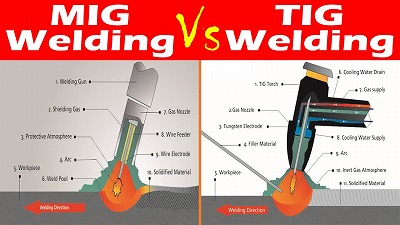
If you’re new to welding, one of the first decisions you’ll face is: TIG or MIG for beginners – which is better?
Both welding methods are widely used across the UK, but they differ significantly in terms of difficulty, cost, speed, and results. Choosing the right one can save you time, money, and frustration.
In this complete beginner-friendly guide, you’ll learn exactly whether TIG or MIG welding is best for beginners, along with a clear comparison to help you decide.
Contents
What is MIG Welding?
MIG (Metal Inert Gas) welding uses a continuous wire feed and shielding gas to create welds.
Key Features:
- Simple trigger operation
- Fast welding speed
- Easy to learn
- Minimal setup complexity
👉 MIG is the most beginner-friendly welding method.
What is TIG Welding?
TIG (Tungsten Inert Gas) welding uses a non-consumable tungsten electrode and requires manual feeding of filler rod.
Key Features:
- High precision
- Cleaner welds
- Requires both hands (and sometimes foot control)
- Slower process
👉 TIG is known for professional, high-quality results.
TIG vs MIG for Beginners: Key Differences
1. Ease of Learning
- MIG Welding: Very easy to learn
- TIG Welding: Difficult (requires coordination and practice)
👉 Winner: MIG
2. Welding Speed
- MIG: Fast and efficient
- TIG: Slow and controlled
👉 Winner: MIG
3. Weld Quality
- MIG: Good quality
- TIG: Exceptional, clean, precise welds
👉 Winner: TIG
4. Equipment Cost (UK)
- MIG Welders: More affordable
- TIG Welders: More expensive (especially AC/DC models)
👉 Winner: MIG
5. Materials You Can Weld
- MIG: Best for steel and thicker materials
- TIG: Works on steel, aluminium, stainless steel, and more
👉 Winner: TIG
6. Thin Metal Welding
- MIG: Can be tricky
- TIG: Excellent control
👉 Winner: TIG
Pros and Cons for Beginners
MIG Welding Pros
- Easy to learn quickly
- Fast results
- Lower cost
- Great for DIY projects
MIG Welding Cons
- Less precise
- More spatter
- Limited control on very thin materials
TIG Welding Pros
- Highest weld quality
- Clean and precise
- Works on more materials
- Ideal for thin metal
TIG Welding Cons
- Harder to learn
- Slower process
- Higher cost
- Requires more coordination
Which is Better for Beginners?
👉 MIG welding is the best choice for beginners
Why MIG is Better:
- Simple to use (just pull the trigger)
- Faster learning curve
- Lower initial investment
- Suitable for most DIY and home projects
👉 Most beginners in the UK start with MIG before moving to TIG later.
When Should Beginners Choose TIG Instead?
You might choose TIG as a beginner if you:
- Want perfect-looking welds
- Work with aluminium or stainless steel
- Focus on precision projects
- Are willing to invest time learning
👉 TIG is great if you’re aiming for professional-level skills from the start.
MIG vs TIG for DIY Projects
- MIG: Ideal for general repairs, brackets, gates, car work
- TIG: Ideal for decorative work, thin materials, and detailed fabrication
👉 Winner for DIY: MIG
MIG vs TIG Learning Curve
- MIG: Learn basics in a few hours
- TIG: Takes weeks or months to master
👉 If you want quick results → choose MIG
👉 If you want mastery → learn TIG later
Final Verdict: TIG or MIG for Beginners
There’s a clear winner for most beginners:
👉 Start with MIG welding
Then:
👉 Move to TIG once you gain experience
This approach gives you:
- Faster progress
- Better confidence
- Strong foundational skills
Final Thoughts
Choosing between TIG and MIG welding as a beginner doesn’t have to be complicated. MIG offers simplicity, speed, and affordability, making it the ideal starting point for most people in the UK.
Once you’ve mastered MIG, transitioning to TIG will open up more advanced opportunities and higher-quality results.
👉 Start simple → build skills → upgrade to TIG

Leave a Reply