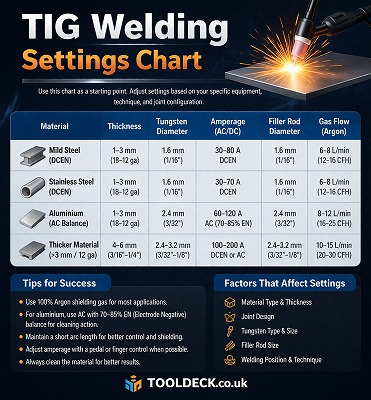
Getting the right settings is the key to successful TIG welding. If your settings are wrong, you’ll struggle with poor penetration, unstable arc, contamination, or messy welds — no matter how good your technique is.
This guide provides a complete TIG welding settings chart, along with detailed explanations to help you understand how to adjust your machine for different materials and thicknesses.
Contents
- 🔧 Why TIG Welding Settings Matter
- 📊 TIG Welding Settings Chart (Steel & Stainless – DC TIG)
- ⚙️ Mild Steel / Stainless Steel Settings
- 📊 TIG Welding Settings Chart (Aluminium – AC TIG)
- ⚙️ Key TIG Welding Settings Explained
- 🧠 How to Set Up Your TIG Welder (Step-by-Step)
- ⚖️ Common Setting Mistakes
- 🛠️ Pro Tips for Welders
- 📈 Beginner Setup Example
- ❓ FAQs
🔧 Why TIG Welding Settings Matter
TIG welding requires precise control over:
- Amperage
- Gas flow
- Tungsten size
- Arc length
- Travel speed
👉 Even small changes can dramatically affect your weld quality.
📊 TIG Welding Settings Chart (Steel & Stainless – DC TIG)
🔥 General Rule:
1 amp per 0.001 inch thickness (approximate)
⚙️ Mild Steel / Stainless Steel Settings
| Material Thickness | Amperage | Tungsten Size | Gas Flow |
|---|---|---|---|
| 1mm | 30–50A | 1.6mm | 6–8 L/min |
| 2mm | 50–80A | 1.6–2.0mm | 6–8 L/min |
| 3mm | 80–110A | 2.4mm | 7–9 L/min |
| 4mm | 100–130A | 2.4mm | 7–10 L/min |
| 5mm | 120–150A | 2.4mm | 8–10 L/min |
| 6mm+ | 150–200A | 2.4–3.2mm | 8–12 L/min |
👉 These settings are ideal for most UK home workshop TIG welding.
📊 TIG Welding Settings Chart (Aluminium – AC TIG)
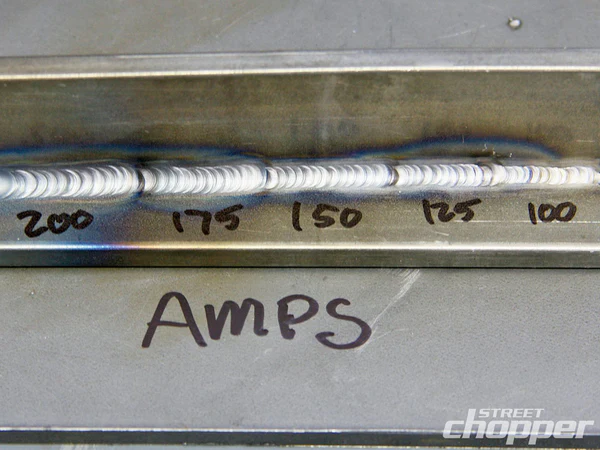
⚙️ Aluminium Settings (AC TIG)
| Thickness | Amperage | Tungsten | Gas Flow |
|---|---|---|---|
| 1mm | 40–70A | 1.6mm | 7–9 L/min |
| 2mm | 70–110A | 2.4mm | 8–10 L/min |
| 3mm | 100–140A | 2.4mm | 8–12 L/min |
| 4mm+ | 140–200A | 2.4–3.2mm | 10–12 L/min |
👉 Aluminium requires AC TIG due to oxide layer removal.
⚙️ Key TIG Welding Settings Explained
🔥 1. Amperage (Most Important Setting)
- Controls heat input
- Affects penetration and bead size
Tips:
- Too low → poor penetration
- Too high → burn-through
👉 Start mid-range and adjust as needed.
💨 2. Gas Flow Rate
- Protects weld from contamination
- Uses argon gas
Recommended:
- 6–10 L/min (steel)
- 8–12 L/min (aluminium)
👉 Too much gas can cause turbulence — not just too little.
🔩 3. Tungsten Size & Type
| Tungsten Size | Amperage Range |
|---|---|
| 1.0mm | 10–70A |
| 1.6mm | 50–120A |
| 2.4mm | 100–200A |
| 3.2mm | 200A+ |
Tip:
- DC TIG → sharp point
- AC TIG → slightly rounded tip
⚡ 4. Polarity (Critical)
- DC TIG → DCEN (Electrode Negative)
- AC TIG → aluminium welding
👉 Wrong polarity = poor weld performance.
🔥 5. Arc Length
- Ideal: 2–3mm
- Too long → unstable arc
- Too short → contamination
⚙️ 6. Travel Speed
- Too fast → poor penetration
- Too slow → wide weld
👉 Consistency is key.
🧠 How to Set Up Your TIG Welder (Step-by-Step)
Step 1: Select Material
- Steel → DC TIG
- Aluminium → AC TIG
Step 2: Set Amperage
- Based on thickness chart above
Step 3: Adjust Gas Flow
- Start around 7–8 L/min
Step 4: Choose Tungsten
- Match size to amperage
Step 5: Test Weld
- Adjust settings as needed
👉 Always test on scrap metal first.
⚖️ Common Setting Mistakes
❌ Too much amperage
✔ Causes burn-through
❌ Too little gas
✔ Leads to contamination
❌ Wrong tungsten size
✔ Affects arc stability
❌ Incorrect polarity
✔ Reduces performance
❌ Ignoring material thickness
✔ Causes poor results
🛠️ Pro Tips for Welders
- Use inverter TIG welders for better control
- Always weld in dry conditions (important in UK climate)
- Keep gas cylinder secure and upright
- Practise on scrap before real projects
- Use HF start for easier ignition
📈 Beginner Setup Example
Welding 2mm Mild Steel:
- Amperage: 60–70A
- Tungsten: 1.6mm
- Gas flow: 7 L/min
- Polarity: DCEN
👉 This is a perfect beginner starting point.
❓ FAQs
What is the best TIG welding setting for beginners?
Start with mid-range amperage and adjust based on weld pool behaviour.
How much gas flow do I need?
Typically 6–10 L/min for steel.
What happens if amperage is too low?
Poor penetration and weak welds.
Do settings change with material?
Yes — aluminium requires AC TIG and different settings.
Final Thoughts
Using the correct TIG welding settings chart is essential for achieving clean, strong, and consistent welds.
👉 Focus on:
- Correct amperage
- Proper gas flow
- Suitable tungsten
- Stable technique
With practice and proper settings, your TIG welding will improve rapidly.




Leave a Reply