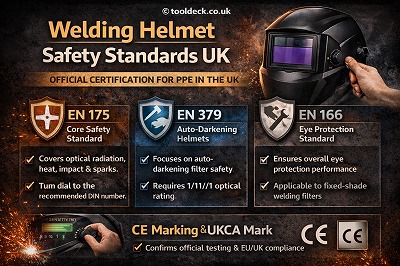
Choosing the right welding helmet is not just about comfort or price — it’s about safety compliance. In the UK, welding helmets must meet strict safety standards to ensure they provide adequate protection against UV radiation, infrared light, and intense welding arcs.
If you’re unsure what certifications to look for, this guide will help you understand everything clearly.
In this complete UK guide, you’ll learn:
- The key welding helmet safety standards in the UK
- What EN379 actually means
- The importance of CE marking
- How to check if your helmet is compliant
- Common mistakes to avoid
Contents
- ⚠️ Why Welding Helmet Safety Standards Matter
- 🔍 Main Welding Helmet Safety Standards in the UK
- ⚙️ How to Check If a Welding Helmet Meets UK Standards
- ⚠️ What Happens If You Use a Non-Certified Helmet?
- ⚖️ Certified vs Non-Certified Helmets
- 🧠 Pro Tips for Welders
- ❌ Common Mistakes to Avoid
- 🛡️ Minimum Safety Requirements in the UK
- ❓ FAQs
⚠️ Why Welding Helmet Safety Standards Matter
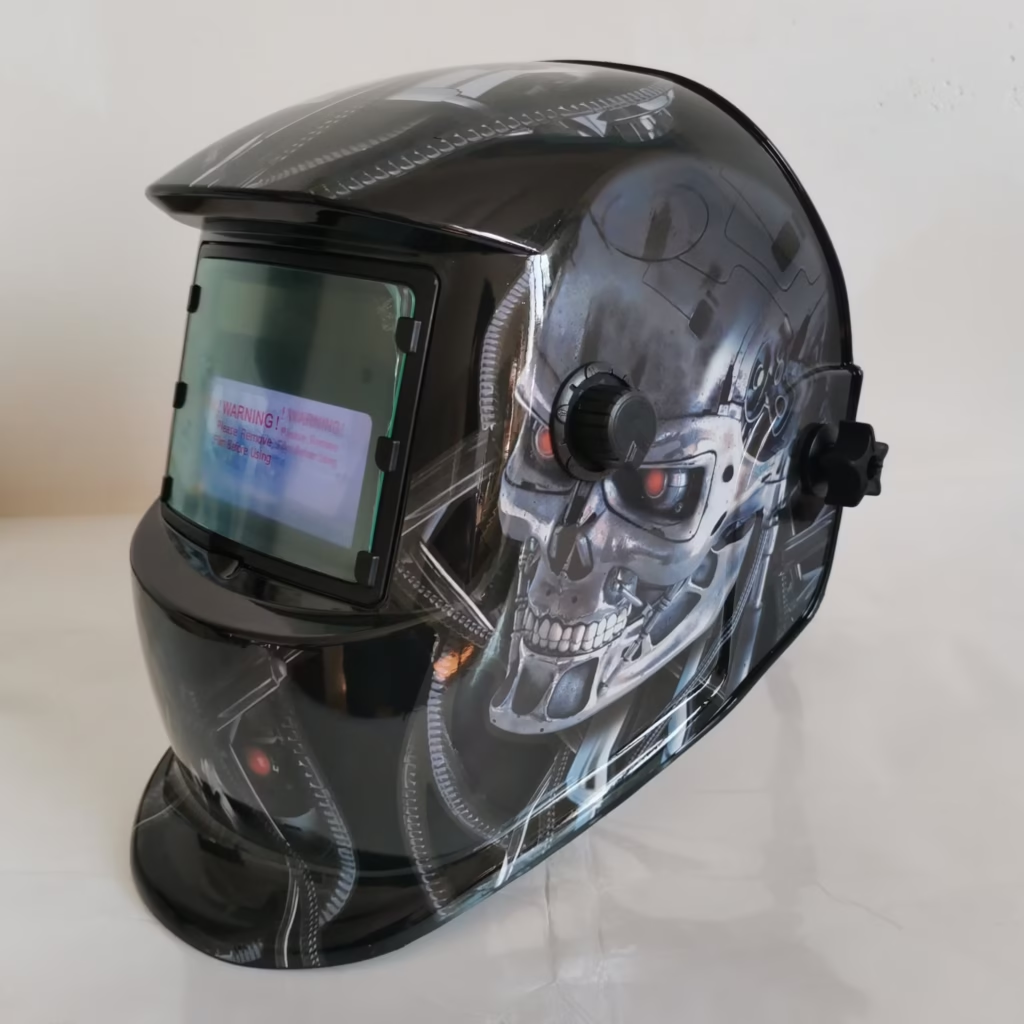
Welding produces extremely intense light and radiation, including:
- Ultraviolet (UV) radiation
- Infrared (IR) radiation
- High-intensity visible light
🔥 Without proper certification, a helmet may:
- Fail to block harmful radiation
- React too slowly to the arc
- Provide inconsistent protection
👉 Certified helmets are tested to ensure reliable, consistent protection.
🔍 Main Welding Helmet Safety Standards in the UK
🔹 1. EN379 – Auto-Darkening Welding Filter Standard
📘 What Is EN379?
EN379 is the European standard specifically for auto-darkening welding filters (ADF) used in welding helmets.
🧪 What EN379 Tests:
- Optical clarity
- Light transmission
- Reaction time (switching speed)
- UV/IR protection levels
- Uniformity across the lens
🔢 EN379 Classification Explained
You may see ratings like:
1/1/1/1 (Best Quality)
Breakdown:
| Rating Position | Meaning |
|---|---|
| 1st | Optical clarity |
| 2nd | Diffusion of light |
| 3rd | Shade consistency |
| 4th | Angle dependence |
👉 Lower numbers = better performance
👉 1/1/1/1 is the highest quality rating
🔹 2. CE Marking (UK & EU Compliance)
📘 What Is CE Marking?
CE marking indicates that the product meets EU safety, health, and environmental requirements, which are still widely recognised in the UK.
✔ What It Confirms:
- Product meets safety standards
- Manufacturer compliance
- Suitable for use in UK/EU
👉 Always look for CE marking on welding helmets.
🔹 3. EN166 – General Eye Protection Standard
📘 What Is EN166?
EN166 covers general eye protection, including:
- Impact resistance
- Optical quality
- Durability
✔ Why It Matters:
Even with auto-darkening features, helmets must also:
- Withstand physical impact
- Protect against flying debris
👉 EN166 ensures basic physical protection.
🔹 4. EN175 – Welding Equipment Protection
📘 What Is EN175?
EN175 applies to welding face shields and helmets.
✔ It Tests:
- Mechanical strength
- Heat resistance
- Stability
👉 Ensures helmet structure is safe under welding conditions.
⚙️ How to Check If a Welding Helmet Meets UK Standards
🔍 1. Check the Lens Markings
Look for:
- EN379 rating
- Shade range
- Optical class
🔍 2. Inspect the Helmet Body
Check for:
- CE marking
- EN175 certification
🔍 3. Read Product Specifications
- Confirm compliance in product description
- Avoid unclear or missing certifications
🔍 4. Buy from Trusted UK Retailers
- Avoid unverified imports
- Stick to recognised brands
👉 Certification should always be clearly stated.
⚠️ What Happens If You Use a Non-Certified Helmet?
Using a non-certified helmet can result in:
- Inadequate UV/IR protection
- Delayed lens response
- Increased risk of arc eye
- Poor weld visibility
👉 This is a serious safety risk — not worth saving money.
⚖️ Certified vs Non-Certified Helmets
| Feature | Certified Helmet | Non-Certified Helmet |
|---|---|---|
| UV/IR Protection | Guaranteed | Unreliable |
| Reaction Time | Tested | Unknown |
| Optical Quality | High | Inconsistent |
| Safety | High | Risky |
👉 Always choose certified helmets.
🧠 Pro Tips for Welders
- Always choose helmets with EN379 1/1/1/1 rating
- Check CE marking before purchase
- Replace damaged lenses immediately
- Avoid extremely cheap helmets
- Test helmet before each use
❌ Common Mistakes to Avoid
❌ Buying based on price only
✔ Prioritise safety certifications
❌ Ignoring EN ratings
✔ Always check EN379
❌ Using damaged helmet
✔ Replace immediately
🛡️ Minimum Safety Requirements in the UK
For safe welding, your helmet should have:
- EN379 certification (ADF)
- EN166 compliance
- EN175 compliance
- CE marking
👉 These ensure full protection.
❓ FAQs
What is the most important welding helmet standard?
EN379 for auto-darkening filters.
Is CE marking required in the UK?
Yes — it confirms safety compliance.
What is the best EN379 rating?
1/1/1/1 (highest quality).
Can cheap helmets be safe?
Only if they meet certification standards.
🏁 Final Thoughts
Choosing a helmet that meets Welding Helmet Safety Standards UK is essential for safe and effective welding. Always look for EN379 certification, CE marking, and proper ratings to ensure your helmet provides reliable protection.

Leave a Reply