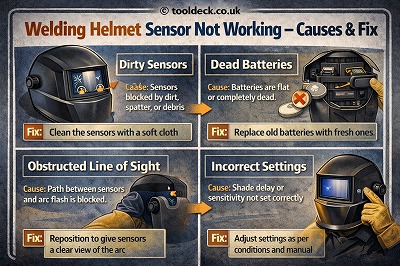
If your welding helmet sensor is not working properly, your helmet may fail to detect the arc — meaning it won’t darken, reacts slowly, or behaves inconsistently. This is not just inconvenient; it’s a serious safety hazard that can expose your eyes to harmful radiation within milliseconds.
In this detailed UK guide, we’ll break down everything you need to know, including:
- How welding helmet sensors actually work
- The most common causes of sensor failure
- Step-by-step troubleshooting and fixes
- When it’s time to repair or replace your helmet
Contents
- ⚠️ Why a Faulty Welding Helmet Sensor Is Dangerous
- 🔍 How Welding Helmet Sensors Work
- ⚠️ Main Causes of Sensor Failure & Detailed Fixes
- ❌ 1. Dirty, Obstructed, or Damaged Sensors (Most Common Issue)
- ❌ 2. Weak, Dead, or Unstable Battery
- ❌ 3. Sensitivity Setting Too Low
- ❌ 4. Sensor Line-of-Sight Blocked
- ❌ 5. Scratched or Cloudy Outer Cover Lens
- ❌ 6. Moisture, Condensation, or Cold Conditions
- ❌ 7. Internal Sensor or Circuit Failure
- ❌ 8. Low-Quality Helmet (Common in Budget Models)
- 🛠️ Complete Troubleshooting Checklist
- ⚖️ Sensor Issues vs Other Helmet Problems
- 🧠 Pro Tips for Welders
- ❌ Common Mistakes to Avoid
- 🛡️ Safety Guidelines
- ❓ FAQs
⚠️ Why a Faulty Welding Helmet Sensor Is Dangerous
The sensors in your helmet are responsible for detecting the welding arc instantly. If they fail:
- The helmet may not darken at all
- It may flicker or respond inconsistently
- There may be a dangerous delay in darkening
🔥 Immediate risks:
- Arc eye (welder’s flash)
- Eye irritation and pain
- Temporary vision loss
⚠️ Long-term risks:
- Permanent eye damage
- Increased sensitivity to light
- Reduced visual clarity
👉 Even a fraction of a second of exposure can cause injury — never weld with faulty sensors.
🔍 How Welding Helmet Sensors Work
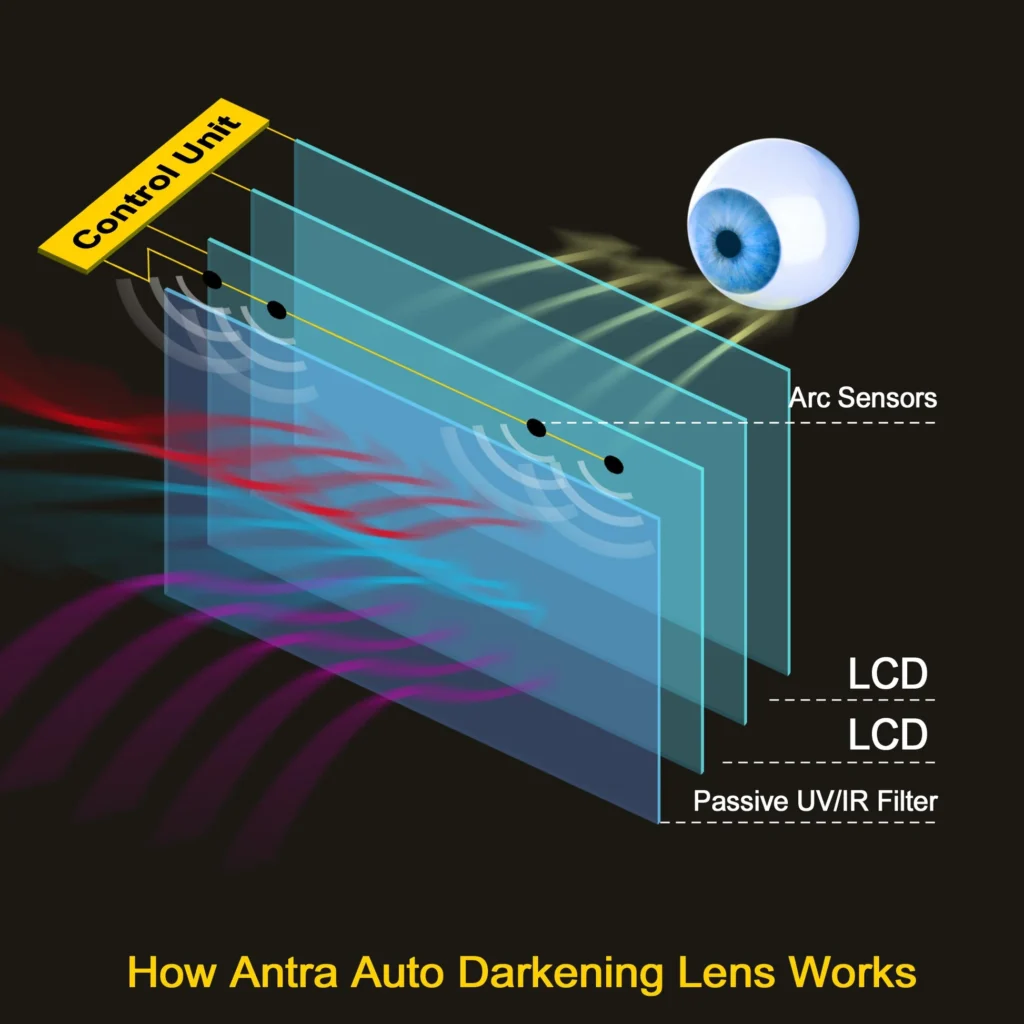
Auto-darkening welding helmets rely on optical arc sensors, typically 2–4 positioned on the front of the helmet.
⚙️ Step-by-Step Process:
- Arc is struck
- Sensors detect a sudden increase in brightness
- Signal is sent to the LCD filter
- Lens darkens instantly (within milliseconds)
🔋 What Sensors Depend On:
- Clean optical surface
- Adequate power supply
- Correct sensitivity settings
- Clear line of sight to the arc
👉 If any of these conditions are not met, the sensor may fail.
⚠️ Main Causes of Sensor Failure & Detailed Fixes
❌ 1. Dirty, Obstructed, or Damaged Sensors (Most Common Issue)
🔍 Why It Happens:
Sensors are exposed to harsh workshop conditions and can be affected by:
- Welding spatter
- Dust and debris
- Oil, grease, or fingerprints
- Scratched outer lens
Even partial obstruction can prevent accurate detection.
🔧 Step-by-Step Fix:
- Identify sensor locations (usually small dark circles)
- Clean gently using a microfibre cloth
- Use lens cleaner if necessary
- Inspect outer cover lens
- Replace cover lens if scratched or cloudy
💡 Pro Tip:
Replace outer lens regularly — it’s cheap and critical for performance.
❌ 2. Weak, Dead, or Unstable Battery
🔍 Why It Happens:
Sensors require consistent power to function correctly. When battery voltage drops:
- Sensors may fail to trigger
- Detection becomes inconsistent
- Helmet may flicker or not darken at all
🔧 Step-by-Step Fix:
- Open battery compartment
- Replace with correct battery type (commonly CR2032)
- Check for corrosion or dirt on contacts
- Clean terminals if needed
- Ensure battery is installed correctly
💡 Important Note:
Even solar-powered helmets rely on internal batteries — solar alone is not enough.
❌ 3. Sensitivity Setting Too Low
🔍 Why It Happens:
Sensitivity controls how easily the sensors detect light changes.
- Low sensitivity → sensors ignore weaker arcs
- Common with low-amperage TIG welding
🔧 How to Fix:
- Increase sensitivity gradually
- Test helmet with arc
- Adjust until consistent detection
💡 Pro Tip:
- TIG welding → high sensitivity
- MIG welding → medium sensitivity
- Outdoor welding → lower sensitivity
❌ 4. Sensor Line-of-Sight Blocked
🔍 Why It Happens:
Sensors must “see” the arc directly. Detection can fail if:
- Torch blocks sensor view
- Workpiece blocks light
- Welding angle is too tight
🔧 Fix:
- Adjust head position
- Ensure sensors face arc
- Avoid covering sensors with hands
👉 Very common in confined welding positions.
❌ 5. Scratched or Cloudy Outer Cover Lens
🔍 Why It Happens:
The outer lens protects sensors and filter. If damaged:
- Light is distorted
- Sensors receive inconsistent signals
🔧 Fix:
- Replace outer cover lens
- Clean regularly
👉 This is one of the easiest and cheapest fixes.
❌ 6. Moisture, Condensation, or Cold Conditions
🔍 Why It Happens:
In UK environments:
- Cold garages → condensation forms
- Moisture interferes with sensors and electronics
🔧 Fix:
- Store helmet in dry indoor space
- Let helmet reach room temperature before use
- Use silica gel packs in storage
❌ 7. Internal Sensor or Circuit Failure
🔍 Why It Happens:
Caused by:
- Age and wear
- Dropping helmet
- Manufacturing defects
🔧 Fix:
- Replace lens cartridge (if possible)
- Replace helmet if not repairable
⚠️ Warning:
Persistent failure usually means internal damage — replacement is safest.
❌ 8. Low-Quality Helmet (Common in Budget Models)
🔍 Why It Happens:
Cheap helmets often have:
- Fewer sensors (2 vs 4)
- Lower detection accuracy
- Slower response time
🔧 Fix:
- Upgrade to a higher-quality helmet
- Look for EN379 certification
👉 Better helmets = better safety and performance.
🛠️ Complete Troubleshooting Checklist
Follow this structured process:
✅ Step 1: Replace battery
✅ Step 2: Clean sensors thoroughly
✅ Step 3: Check and adjust sensitivity
✅ Step 4: Inspect outer lens
✅ Step 5: Adjust welding position
✅ Step 6: Eliminate moisture issues
✅ Step 7: Test helmet with arc
✅ Step 8: Replace if necessary
👉 This process resolves 90–95% of issues.
⚖️ Sensor Issues vs Other Helmet Problems
| Problem | Sensor Fault | Battery Issue | Settings Issue |
|---|---|---|---|
| No darkening | ✔ | ✔ | ✔ |
| Flickering | ✔ | ✔ | ✔ |
| Delayed reaction | ✔ | ✔ | ✔ |
👉 Sensor issues often overlap with other causes.
🧠 Pro Tips for Welders
- Clean sensors weekly
- Replace outer lens regularly
- Store helmet in dry conditions
- Avoid dropping helmet
- Test before every welding session
- Keep spare batteries available
❌ Common Mistakes to Avoid
❌ Ignoring dirty sensors
✔ Clean regularly
❌ Blocking sensors unknowingly
✔ Be aware of positioning
❌ Using scratched lenses
✔ Replace immediately
❌ Continuing to weld with faulty helmet
✔ Always fix or replace
🛡️ Safety Guidelines
Choose helmets that meet:
- EN379 (auto-darkening standard)
- CE certification
👉 Ensures reliable protection against UV/IR radiation.
❓ FAQs
Why is my welding helmet sensor not detecting the arc?
Most likely due to dirt, low sensitivity, or battery issues.
Can I fix sensor issues myself?
Yes — most problems are simple to fix.
How do I test the sensors?
Strike an arc safely and observe the helmet response.
When should I replace my helmet?
If sensors fail after full troubleshooting.
🏁 Final Thoughts
If your welding helmet sensor is not working, treat it as a critical safety issue.
👉 Always check:
- Sensor condition
- Battery health
- Settings
- Helmet integrity
If the problem persists, replace the helmet immediately — your eyesight is not worth the risk.



Leave a Reply