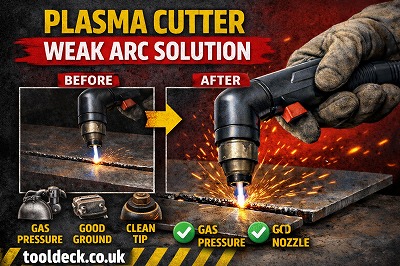
If your plasma cutter has a weak arc, it can seriously affect your cutting performance. Instead of clean, fast cuts, you may experience:
- Poor penetration
- Rough edges
- Slow cutting speed
- Excessive slag (dross)
This is a common issue for UK users, especially in home workshops and DIY setups. The good news is that most weak arc problems are caused by simple, fixable issues.
In this guide, you’ll learn:
- What causes a weak plasma arc
- Step-by-step solutions
- How to improve cutting performance
- Pro tips to prevent the issue
⚠️ Signs of a Weak Plasma Arc
Before fixing the issue, confirm these symptoms:
- ❌ Arc starts but struggles to cut through
- ❌ Cutting is slow or inconsistent
- ❌ Excessive slag on edges
- ❌ Arc looks unstable or weak
- ❌ Poor cut quality
👉 These indicate insufficient arc power or stability.
Plasma Cutter Weak Arc Solution – Common Causes & Solutions
🔹 1. Low or Incorrect Amperage Settings
❌ Why It Happens:
- The amperage is set too low for the material thickness
- Machine output is limited due to incorrect settings
- Beginners often underestimate required amps
🔍 Symptoms:
- Arc starts but struggles to penetrate
- Cutting feels slow and inconsistent
- Sparks don’t pass through the metal
✅ Solution:
- Increase amperage according to material thickness:
- 1–3 mm steel → ~20–30A
- 5–10 mm steel → ~40–60A
- 10mm+ steel → 60A+
- Always refer to your machine’s cutting chart
👉 Pro Tip: If sparks are not exiting the bottom of the material, your amperage is too low.
🔹 2. Worn or Low-Quality Consumables
❌ Why It Happens:
- Electrodes wear down over time
- Nozzles become enlarged or damaged
- Cheap consumables degrade faster
🔍 Symptoms:
- Arc appears weak or inconsistent
- Cut quality suddenly drops
- Difficulty maintaining stable arc
✅ Solution:
- Inspect regularly:
- Electrode tip (pitting or wear)
- Nozzle opening (deformation)
- Replace consumables as a set if worn
- Use high-quality, compatible parts
👉 Pro Tip: Even slightly worn consumables can reduce arc strength by 30–50%.
🔹 3. Incorrect Air Pressure or Airflow
❌ Why It Happens:
- Air pressure too low → insufficient plasma force
- Air pressure too high → unstable arc
- Compressor cannot maintain constant pressure
🔍 Symptoms:
- Weak or fluctuating arc
- Excessive slag
- Inconsistent cutting performance
✅ Solution:
- Set correct pressure (typically 60–90 PSI)
- Check airflow under load (not just idle)
- Ensure compressor capacity matches plasma cutter requirements
👉 Pro Tip: Always check pressure while cutting, not just when the machine is idle.
🔹 4. Moisture or Contaminated Air Supply
❌ Why It Happens:
- Condensation builds up in compressor tank
- No air dryer or filter installed
- Humid UK weather conditions
🔍 Symptoms:
- Weak or unstable arc
- Rapid consumable wear
- Spitting or irregular plasma stream
✅ Solution:
- Install:
- Air dryer
- Moisture filter
- Drain compressor tank daily
- Use desiccant filters for best results
👉 Pro Tip: Moisture is one of the biggest hidden causes of weak plasma arc performance.
🔹 5. Poor Ground (Earth) Connection
❌ Why It Happens:
- Ground clamp attached to painted, rusty, or dirty surface
- Loose or weak connection
- Poor electrical conductivity
🔍 Symptoms:
- Weak or intermittent arc
- Difficulty starting cut
- Arc drops out during cutting
✅ Solution:
- Attach clamp to clean, bare metal
- Grind surface if necessary
- Ensure tight, secure connection
👉 Pro Tip: A bad ground can reduce arc power dramatically—even if everything else is correct.
🔹 6. Incorrect Torch Height (Standoff Distance)
❌ Why It Happens:
- Holding torch too far from workpiece
- Inconsistent hand movement
- No use of guides or spacers
🔍 Symptoms:
- Weak arc
- Wide, messy cuts
- Reduced penetration
✅ Solution:
- Maintain correct standoff:
- Typically 2–4 mm from surface
- Use drag shield if available
- Keep movement steady
👉 Pro Tip: Even a few millimetres too far can weaken the arc significantly.
🔹 7. Cutting Too Fast
❌ Why It Happens:
- Moving torch faster than arc can cut
- Trying to speed up work
🔍 Symptoms:
- Incomplete cuts
- Weak penetration
- Sparks not exiting bottom
✅ Solution:
- Slow down cutting speed
- Maintain consistent motion
- Watch spark direction:
- Straight down = correct speed
👉 Pro Tip: Let the plasma do the work—don’t force it.
🔹 8. Power Supply Issues
❌ Why It Happens:
- Voltage drop from long extension leads
- Inconsistent power supply
- Undersized circuit
🔍 Symptoms:
- Weak arc output
- Machine struggles under load
- Reduced cutting power
✅ Solution:
- Plug directly into mains (UK 230V)
- Avoid long or thin extension leads
- Use proper circuit rating
👉 Pro Tip: Power issues are often overlooked but can severely affect performance.
🔹 9. Machine Overheating or Duty Cycle Limits
❌ Why It Happens:
- Running machine beyond duty cycle
- Poor ventilation
- Long continuous use
🔍 Symptoms:
- Weak arc after extended use
- Machine shuts down or reduces output
- Warning lights (on some models)
✅ Solution:
- Allow machine to cool
- Follow duty cycle guidelines
- Ensure proper airflow around machine
👉 Pro Tip: Heat reduces efficiency before shutdown happens.
🔹 10. Incorrect Machine Setup or Settings
❌ Why It Happens:
- Wrong mode selected
- Incorrect setup for material type
- User error (common for beginners)
🔍 Symptoms:
- Weak or inconsistent arc
- Poor overall performance
✅ Solution:
- Double-check all settings
- Follow manufacturer guidelines
- Use recommended presets if available
👉 Pro Tip: Always review setup before assuming hardware failure.
A plasma cutter weak arc is almost always caused by incorrect setup, poor airflow, worn consumables, or grounding issues. By systematically checking each of these factors, you can quickly restore full cutting performance.
🧠 Step-by-Step Quick Fix Checklist
- ✅ Increase amperage
- ✅ Replace consumables
- ✅ Check air pressure
- ✅ Improve grounding
- ✅ Clean air supply
- ✅ Adjust torch height
- ✅ Slow down cutting
👉 These steps solve most issues.
🧠 Pro Tips to Improve Arc Strength
- Use high-quality consumables
- Keep air dry and clean
- Maintain consistent torch movement
- Regularly service your machine
- Use correct settings for each job
❌ Common Mistakes to Avoid
❌ Ignoring consumables
✔ Replace regularly
❌ Wrong air pressure
✔ Adjust properly
❌ Poor grounding
✔ Ensure clean contact
🛡️ Safety Tips
- Wear protective gear
- Ensure proper ventilation
- Avoid overheating
❓ FAQs
Why is my plasma cutter arc weak?
Usually due to low amperage, air issues, or worn consumables.
Can air pressure affect arc strength?
Yes — significantly.
How do I fix weak arc quickly?
Check consumables, air, and settings.
Is weak arc dangerous?
It can reduce efficiency and cause poor cuts.
🏁 Final Thoughts
If you’re dealing with a plasma cutter weak arc, the issue is often caused by incorrect settings, poor airflow, or worn consumables. By following the solutions in this guide, you can restore full cutting power and achieve clean, efficient results.



Leave a Reply