Struggling with gaps, uneven joints, or cuts that don’t line up? You’re not alone. Even high-quality tools can produce poor results if they’re not set up correctly. Learning how to improve mitre saw accuracy is essential for achieving clean, professional cuts—whether you’re a DIYer or a tradesperson in the UK.
In this guide, you’ll discover practical, proven ways to increase precision and eliminate common cutting errors.
Why Mitre Saw Accuracy Matters
Poor accuracy leads to:
- Gaps in skirting boards and joints
- Wasted materials
- Extra sanding and rework
- Unprofessional finishes
👉 Small errors (even 1°) can ruin a project.
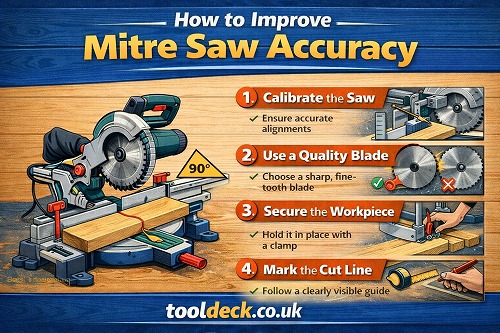
1. Calibrate Your Mitre Saw Properly
The most important step.
What to check:
- Blade is square to the table (90°)
- Fence is perfectly aligned
- Mitre and bevel angles are accurate
👉 If your saw isn’t calibrated, nothing else will fix accuracy.
2. Use a High-Quality Blade
A poor blade = poor cuts.
✔ Recommended:
- 60–80 teeth for fine work
- Carbide-tipped blades
❌ Avoid:
- Cheap or dull blades
👉 Better blade = smoother, cleaner, more precise cuts.
3. Secure Your Material Firmly
Movement during cutting is a major cause of inaccuracy.
✔ Best practice:
- Use clamps whenever possible
- Press material firmly against the fence
👉 Even slight movement ruins precision.
4. Improve Your Cutting Technique
Technique matters more than many people realise.
✔ Correct method:
- Let the blade reach full speed
- Lower slowly and smoothly
- Don’t force the cut
👉 Smooth control = better accuracy.
5. Use Stop Blocks for Repeat Cuts
Perfect for consistency.
Benefits:
- Identical cuts every time
- Faster workflow
- Reduced measuring errors
👉 Essential for batch cutting.
6. Keep the Saw Clean
Dust buildup affects accuracy.
Focus on:
- Fence
- Base
- Rails (for sliding saws)
👉 A clean saw performs better.
7. Check Your Measurements Carefully
Even perfect cuts won’t fit if measurements are wrong.
✔ Tips:
- Measure twice, cut once
- Mark clearly
- Mark the waste side
8. Use a Laser Guide (If Available)
Many modern mitre saws include laser guides.
Benefits:
- Better alignment
- Faster setup
👉 But always verify manually for precision work.
9. Support Long Materials
Unsupported material can shift or sag.
✔ Use:
- Saw stands
- Roller supports
👉 Stability improves accuracy significantly.
10. Practice with Test Cuts
Before cutting expensive material:
- Use scrap wood
- Test angles and fit
👉 Saves time and money.
Common Accuracy Problems & Fixes
❌ Gaps in Corners
👉 Cause: Incorrect mitre angle or poor measurement
❌ Cuts Not Straight
👉 Cause: Fence misalignment or blade issue
❌ Rough Edges
👉 Cause: Dull or low-quality blade
❌ Inconsistent Cuts
👉 Cause: Poor technique or no stop block
Pro Tips for UK Users
- UK homes often have uneven walls → expect adjustments
- MDF requires fine blades for clean edges
- Regularly recalibrate if transporting your saw
- Combine accuracy with proper installation techniques
Accuracy Checklist
✔ Saw calibrated
✔ Blade sharp and suitable
✔ Material secured
✔ Fence clean
✔ Technique controlled
✔ Test cuts completed
❓ FAQs: Improving Mitre Saw Accuracy
Why is my mitre saw not cutting accurately?
Common causes include poor calibration, a dull blade, incorrect technique, or loose material during cutting.
How do I make my mitre saw more accurate?
Calibrate the saw, use a high-quality blade, secure your material, and use stop blocks for consistent cuts.
Does blade quality affect accuracy?
Yes, a high-quality, sharp blade produces cleaner and more precise cuts compared to cheap or worn blades.
How often should I calibrate my mitre saw?
DIY users should check every few months, while professionals should calibrate more frequently or after transport.
Can a beginner achieve accurate cuts with a mitre saw?
Yes, with proper setup, practice, and attention to detail, beginners can achieve highly accurate results.
What is the biggest mistake affecting accuracy?
The most common issue is using an uncalibrated saw combined with poor cutting technique.
Final Thoughts
Improving mitre saw accuracy isn’t about one single fix—it’s about combining proper setup, good tools, and correct technique. Once everything is dialled in, your cuts will be cleaner, tighter, and far more professional.
👉 Key takeaway:
- Calibration is critical
- Technique matters
- Small improvements make a big difference



Leave a Reply