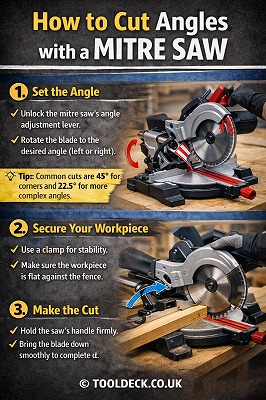
Cutting accurate angles is one of the main reasons people invest in a mitre saw. Whether you’re fitting skirting boards, installing architraves, or building frames, learning how to cut angles with a mitre saw is essential for clean, professional results.
In this UK-focused guide, you’ll learn exactly how to cut mitre and bevel angles, avoid common mistakes, and achieve perfect joints every time.
What Are Angle Cuts on a Mitre Saw?
There are two main types of angle cuts:
1. Mitre Cuts (Horizontal Angles)
- The blade rotates left or right
- Used for corners (e.g. 45° cuts for frames)
👉 Example: Picture frames, skirting corners
2. Bevel Cuts (Vertical Angles)
- The blade tilts left or right
- Used for sloped or angled edges
👉 Example: Crown moulding, decorative trims
Tools & Setup You’ll Need
Before you start:
- Mitre saw (single or double bevel)
- Measuring tape
- Pencil for marking
- Clamp (recommended)
- Safety gear (goggles, ear protection)
👉 Always work on a stable, flat surface.
Step-by-Step: How to Cut a Mitre Angle
Step 1: Measure and Mark
- Measure your material carefully
- Mark the cut line clearly with a pencil
💡 UK Tip: Always double-check measurements—“measure twice, cut once”.
Step 2: Set the Mitre Angle
- Loosen the mitre lock
- Rotate the table to your desired angle (e.g. 45°)
- Lock it securely
Step 3: Position the Material
- Place the workpiece firmly against the fence
- Align the blade with your mark
- Clamp the material if possible
Step 4: Make the Cut
- Start the saw and let it reach full speed
- Lower the blade slowly into the material
- Do not force the cut
Step 5: Finish Safely
- Wait until the blade stops spinning
- Lift the saw and remove the material
Step-by-Step: How to Cut a Bevel Angle
Step 1: Adjust the Bevel
- Unlock the bevel control
- Tilt the blade to the required angle (e.g. 30°)
- Lock it in place
Step 2: Align Your Material
- Keep the material flat on the table
- Ensure proper support
Step 3: Cut Carefully
- Follow the same cutting process
- Maintain steady control
Common Angle Cuts
45° Mitre Cut
- Used for corners (frames, skirting)
- Most common angle
22.5° Mitre Cut
- Used for bay windows or complex joints
Compound Cuts
- Combination of mitre + bevel
- Used for crown moulding
Tips for Perfect Angle Cuts
✔ Use a Sharp Blade
A dull blade causes rough edges and inaccurate cuts.
✔ Test on Scrap Wood
Always test your angle before cutting expensive materials.
✔ Use Stops for Repeat Cuts
Improves consistency and saves time.
✔ Keep the Fence Clean
Dust buildup can affect accuracy.
Common Mistakes to Avoid
❌ Wrong Angle Direction
Cutting the wrong side is a common beginner mistake.
❌ Not Locking the Angle
Loose settings can ruin your cut.
❌ Rushing the Cut
Leads to poor finish and potential safety risks.
❌ Poor Material Support
Can cause movement and inaccurate cuts.
Pro Tips for Tradespeople
- Use a double bevel mitre saw for faster compound cuts
- Mark waste side clearly before cutting
- Use laser guides (if available) for better accuracy
- Invest in a quality blade for cleaner finishes
When Do You Need Compound Cuts?
Compound cuts are needed when:
- Installing crown moulding
- Working on complex joinery
- Creating angled structures
👉 These cuts require both mitre and bevel adjustments.
Final Thoughts
Learning how to cut angles with a mitre saw is a fundamental skill for any DIYer or professional in the UK. With proper setup, careful measurement, and the right technique, you can achieve clean, precise cuts every time.
👉 Key takeaway:
- Understand the difference between mitre and bevel
- Set angles correctly
- Prioritise accuracy over speed



Leave a Reply