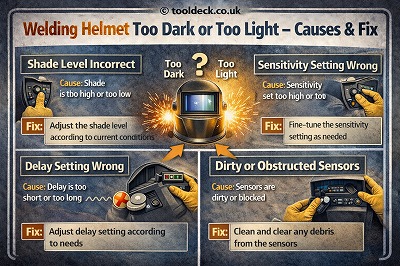
A welding helmet that is too dark or too light can seriously affect both your safety and weld quality. If it’s too dark, you won’t see the weld pool clearly. If it’s too light, your eyes are exposed to harmful radiation.
Getting the correct balance is essential — and fortunately, most issues can be fixed with simple adjustments.
In this complete UK guide, you’ll learn:
- Why your welding helmet is too dark or too light
- How to fix it step by step
- The correct shade settings for different welding processes
- Pro tips for better visibility and safety
⚠️ Why Correct Helmet Shade Matters
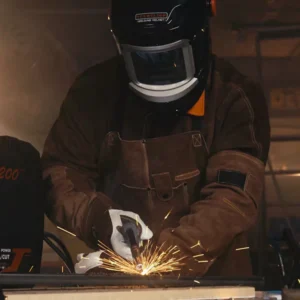
The lens shade controls how much light reaches your eyes.
🔥 If Helmet Is Too Dark:
- Difficult to see weld pool
- Poor weld accuracy
- Increased mistakes
⚠️ If Helmet Is Too Light:
- Risk of arc eye
- Eye strain and fatigue
- Long-term damage
👉 Correct shade = clear visibility + full protection
🔍 How Welding Helmet Shade Works
Auto-darkening helmets adjust between:
- Light state: Shade 3–4
- Dark state: Shade 9–13 (or higher)
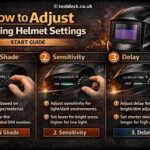
🎛️ Adjustable Settings:
- Shade level
- Sensitivity
- Delay
👉 Incorrect settings are the most common cause of problems.
⚠️ Main Causes & Fixes
❌ 1. Incorrect Shade Setting (Most Common)
🔍 Why It Happens:
- Shade set too high → too dark
- Shade set too low → too bright
🔧 How to Fix:
- Locate shade control dial
- Adjust gradually
- Test while welding
💡 Tip:
Start at shade 10–11 and adjust from there.
❌ 2. Wrong Settings for Welding Process
🔍 Why It Happens:
Different processes require different shades:
- TIG → lower shade
- MIG → medium
- Stick → higher
🔧 Fix:
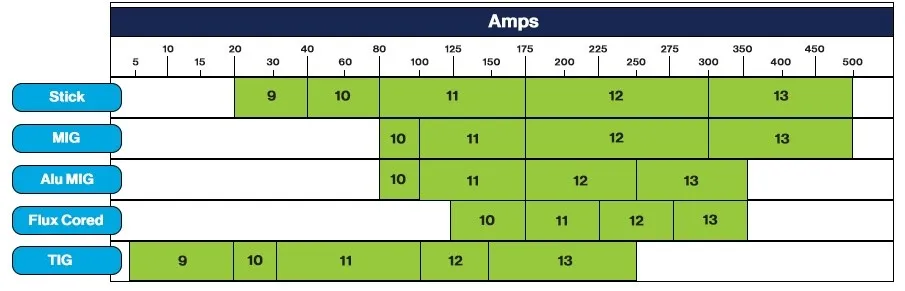
Adjust based on welding type (see chart below).
📊 Recommended Shade Settings
| Welding Type | Amperage | Recommended Shade |
|---|---|---|
| TIG | 10–100A | 9–11 |
| TIG | 100–200A | 11–12 |
| MIG | 100–200A | 10–12 |
| Stick | 100–300A | 11–13 |
👉 Always match shade to amperage.
❌ 3. Sensitivity Setting Too High or Too Low
🔍 Why It Happens:
- High sensitivity → over-darkening
- Low sensitivity → insufficient darkening
🔧 Fix:
- Adjust sensitivity gradually
- Test with arc
❌ 4. Dirty or Damaged Lens
🔍 Why It Happens:
- Dirt reduces visibility → appears too dark
- Scratches distort light
🔧 Fix:
- Clean lens regularly
- Replace outer cover lens if scratched
❌ 5. Poor Lighting Conditions
🔍 Why It Happens:
- Dark workshop → helmet feels too dark
- Bright environment → helmet seems too light
🔧 Fix:
- Improve workshop lighting
- Adjust shade accordingly
👉 Lighting plays a big role in perception.
❌ 6. Low Battery or Power Issue
🔍 Why It Happens:
- Helmet may not reach correct shade
- Inconsistent darkening
🔧 Fix:
- Replace batteries
- Check power system
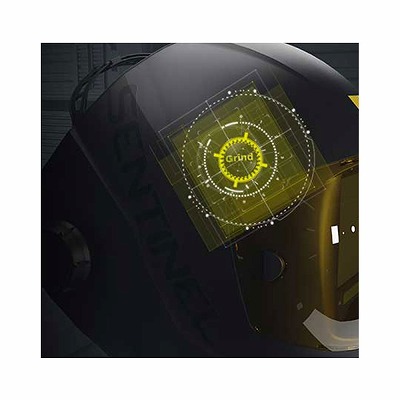
❌ 7. Incorrect Helmet Mode
🔍 Why It Happens:
Helmet set to:
- Grind mode
- Test mode
🔧 Fix:
Switch to WELD mode
🛠️ Step-by-Step Fix Guide
✅ Step 1: Check Shade Setting
Set between 10–12 for most work
✅ Step 2: Adjust Sensitivity
Increase if too light
✅ Step 3: Clean Lens
Remove dirt and debris
✅ Step 4: Check Battery
Replace if needed
✅ Step 5: Improve Lighting
Ensure good visibility
✅ Step 6: Test Helmet
Strike arc and adjust
👉 This resolves most issues quickly.
⚖️ Too Dark vs Too Light – Quick Comparison
| Issue | Too Dark | Too Light |
|---|---|---|
| Visibility | Poor | Clear but unsafe |
| Risk | Low safety risk | High eye risk |
| Fix | Lower shade | Increase shade |
👉 Too light is more dangerous than too dark.
🧠 Pro Tips for UK Welders
- Always test helmet before welding
- Adjust settings for each job
- Keep spare batteries
- Store helmet in dry conditions
- Replace scratched lenses regularly
❌ Common Mistakes to Avoid
❌ Using same shade for all welding
✔ Adjust based on task
❌ Ignoring poor visibility
✔ Fix immediately
❌ Not cleaning lens
✔ Reduces clarity
❌ Using cheap helmets
✔ Limited adjustment range
🛡️ Safety Guidelines
- Use helmets meeting EN379 standard
- Never weld with incorrect shade
- Protect eyes at all times
👉 Safety always comes first.
❓ FAQs
Why is my welding helmet too dark?
Shade setting too high or poor lighting.
Why is it too light?
Shade too low or sensitivity too low.
What shade should I use?
Usually 10–12 depending on welding type.
Can I adjust while welding?
Yes, but test carefully.
🏁 Final Thoughts
If your welding helmet is too dark or too light, it’s usually an easy fix.
👉 Focus on:
- Shade settings
- Sensitivity
- Lighting
- Helmet condition
Getting the correct setup ensures:
- Better visibility
- Safer welding
- Higher-quality results
Leave a Reply