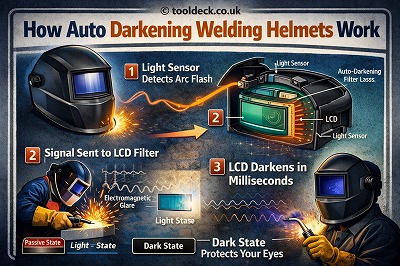
Auto-darkening welding helmets are one of the most important innovations in modern welding. They allow welders to see clearly before striking an arc and then instantly switch to a protective dark shade — all without manual movement.
But behind this convenience is a surprisingly advanced system combining optics, electronics, and liquid crystal technology.
In this detailed UK guide, we’ll break down exactly:
- How auto-darkening welding helmets work step by step
- The science behind the lens technology
- Every key component explained in depth
- What affects performance and reliability
- How to optimise your helmet for the best results
⚠️ Why Understanding How Auto-Darkening Helmets Work Matters
Many welders use these helmets daily without understanding how they function. Knowing how they work helps you:
- Diagnose problems quickly
- Adjust settings correctly
- Improve weld quality
- Ensure maximum eye protection
👉 A well-understood helmet is a safer and more effective tool.
🔍 What Is an Auto-Darkening Welding Helmet?
An auto-darkening welding helmet is a protective helmet equipped with an Auto-Darkening Filter (ADF) — a specialised lens system that automatically adjusts its shade in response to the welding arc.
🔄 Two Key States:
- Light State (Shade 3–4): Clear view before welding
- Dark State (Shade 9–13+): Protection during welding
👉 The transition between these states happens in milliseconds, without any manual input.
⚙️ Core Components (Deep Breakdown)
🔹 1. Optical Arc Sensors
🔍 What They Do:
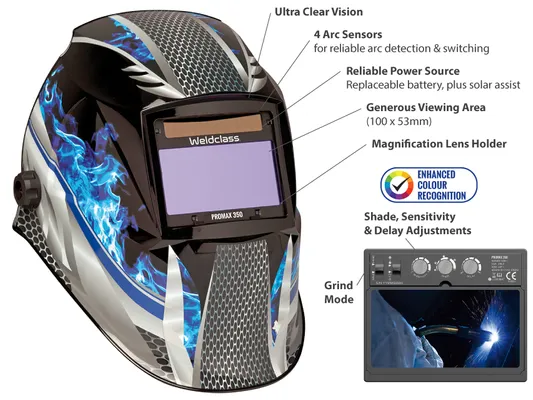
Sensors detect the sudden burst of light when the arc is struck.
🧠 How They Work:
- Sensors measure light intensity
- When brightness exceeds a threshold → signal is triggered
- This signal activates the lens
⚡ Important Details:
- Most helmets have 2–4 sensors
- More sensors = better detection in awkward angles
- Sensors must remain clean and unobstructed
👉 Poor sensor visibility is one of the most common causes of helmet failure.
🔹 2. Auto-Darkening Filter (ADF)
🔍 What It Is:
The ADF is the core optical system inside the helmet that controls light transmission.
🧩 Structure Includes:
- Polarising filters
- Liquid crystal layers
- UV/IR protection layers
⚡ Key Function:
- Controls how much light passes through
- Adjusts shade level automatically
👉 This is the “brain + eyes” of the helmet.
🔹 3. Liquid Crystal Display (LCD) Technology
🧠 The Science Behind It:
The ADF uses liquid crystal molecules that react to electrical signals.
⚙️ How It Works:
- In light state → crystals allow more light through
- When voltage is applied → crystals align to block light
⚡ Result:
- Lens darkens instantly
- Light transmission is reduced to safe levels
👉 This is similar to how LCD screens work — but optimised for eye protection.
🔹 4. UV and IR Protection (Always Active)
⚠️ Critical Safety Feature:
Even if the auto-darkening fails, UV/IR protection remains active at all times.
🔍 How It Works:
- Passive filter layers block harmful radiation
- Independent of electronics
👉 This ensures baseline safety — but does NOT replace proper darkening.
🔹 5. Power System (Battery + Solar)
🔋 Power Sources:
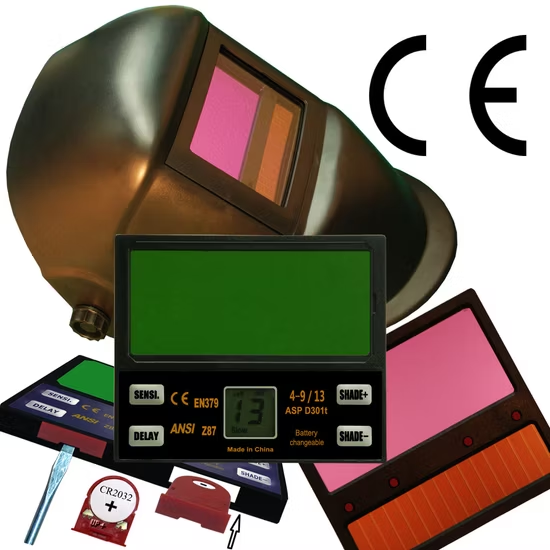
- Replaceable batteries (CR2032, etc.)
- Solar-assisted charging
⚡ How Power Is Used:
- Runs sensors
- Powers LCD switching
- Maintains consistent darkening
💡 Key Insight:
Solar panels support but do not replace batteries.
👉 Weak power = flickering or failure.
🔹 6. Control Panel (User Settings)
🎛️ Adjustable Parameters:
🔹 Shade Level
Controls darkness (e.g. 9–13)
🔹 Sensitivity
Controls how easily sensors detect the arc
🔹 Delay
Controls how long the lens stays dark after welding stops
👉 Proper adjustment is essential for performance.
⚡ Step-by-Step Process (From Arc to Darkening)
🧩 Step 1: Idle State
Helmet is in light mode (clear visibility)
⚡ Step 2: Arc Is Struck
Sensors detect sudden intense light
⚙️ Step 3: Signal Processing
Electronics process signal instantly
🪟 Step 4: LCD Activation
Voltage applied → liquid crystals align
🌑 Step 5: Lens Darkens
Light transmission reduced to safe level
🔄 Step 6: Arc Stops
Delay timer activates → lens returns to light state
👉 Entire process takes microseconds to milliseconds
⚠️ What Affects Performance?
❌ 1. Sensor Condition
- Dirty or blocked → poor detection
❌ 2. Battery Health
- Weak battery → flickering or delay
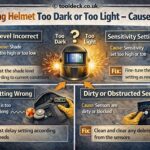
❌ 3. Sensitivity Settings
- Too low → missed arc
- Too high → false triggering
❌ 4. Ambient Lighting
- Too dark → detection issues
- Too bright → interference
❌ 5. Helmet Quality
- Cheap helmets → fewer sensors, slower response
- Premium helmets → stable and accurate
⚖️ Auto-Darkening vs Passive Helmets (Detailed)
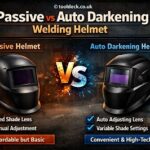
| Feature | Auto-Darkening | Passive |
|---|---|---|
| Visibility Before Welding | Clear | Dark |
| Reaction Time | Instant | Manual |
| Ease of Use | Very high | Low |
| Safety | Higher | Lower |
| Cost | Higher | Lower |
👉 Auto-darkening helmets are now the standard in the UK.
🧠 Pro Tips for Welders
- Always test helmet before welding
- Keep sensors clean
- Replace batteries regularly
- Store in dry environment (important in UK climate)
- Adjust settings per welding type
❌ Common Misconceptions
❌ “Solar helmets don’t need batteries”
✔ False
❌ “All helmets react instantly”
✔ Quality varies
❌ “Faster is always better”
✔ Stability matters more
🛡️ UK Safety Standards
Ensure your helmet meets:
- EN379 (auto-darkening standard)
- CE certification
👉 Guarantees proper protection.
❓ FAQs
How fast do auto-darkening helmets react?
Typically 1/10,000 second or faster.
Do they protect eyes without power?
Yes — UV/IR protection is always active.
Can they fail?
Yes — due to battery, sensors, or damage.
Are they worth it?
Absolutely — safer and more efficient.
🏁 Final Thoughts
Auto-darkening welding helmets combine:
- Optical sensors
- Electronic control systems
- Liquid crystal technology
to deliver instant protection and improved visibility.
Understanding how they work helps you:
- Use them correctly
- Fix problems faster
- Weld safely and efficiently
Leave a Reply