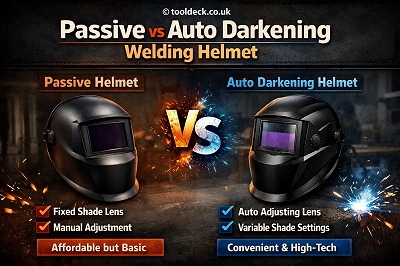
Choosing between a passive vs auto darkening welding helmet is one of the most important decisions for both beginner and experienced welders in the UK.
While both types provide essential protection from harmful UV and IR radiation, they differ significantly in convenience, visibility, performance, and overall safety.
So, which one should you choose?
In this complete UK guide, we’ll cover:
- What passive and auto-darkening helmets are
- Key differences in performance and usability
- Pros and cons of each type
- When to use each
- Expert recommendations for UK welders
⚠️ Why Your Choice of Helmet Matters
Your welding helmet directly affects:
- Eye safety
- Weld accuracy
- Productivity
- Comfort
🔥 Using the wrong type can lead to:
- Poor arc alignment
- Missed starts
- Eye strain
- Reduced weld quality
👉 The right helmet makes welding safer and more efficient.
🔍 What Is a Passive Welding Helmet?
A passive welding helmet (also called a fixed-shade helmet) has a lens that is always dark, typically shade 10 or 11.
🔹 How It Works:
- Lens remains dark at all times
- You must position the helmet before striking the arc
- Often requires a “flip-down” motion
🔹 Key Characteristics:
- Simple design
- No electronics or sensors
- No batteries required
👉 This is the traditional type of welding helmet.
🔍 What Is an Auto Darkening Welding Helmet?
An auto-darkening welding helmet uses an electronic lens (ADF – Auto Darkening Filter) that automatically adjusts shade when it detects the welding arc.
🔹 How It Works:
- Lens stays light before welding
- Sensors detect arc
- Lens darkens instantly (milliseconds)
🔹 Key Features:
- Adjustable shade (typically 9–13)
- Sensitivity and delay controls
- Battery or solar-powered
👉 This is the modern standard in the UK.
⚙️ Key Differences: Passive vs Auto Darkening Welding Helmet
🔹 1. Visibility Before Welding
Passive Helmet:
- Always dark
- Difficult to see workpiece
Auto-Darkening Helmet:
- Clear view before welding
- Easy positioning
👉 Auto-darkening helmets offer a major advantage.
🔹 2. Ease of Use
Passive:
- Requires manual flip
- Slower workflow
Auto-Darkening:
- Fully automatic
- Hands-free
👉 Much more convenient.
🔹 3. Reaction Time
Passive:
- No reaction (always dark)
Auto-Darkening:
- Reacts in milliseconds
👉 Provides dynamic protection.
🔹 4. Adjustability
Passive:
- Fixed shade
Auto-Darkening:
- Adjustable shade, sensitivity, delay
👉 More versatile.
🔹 5. Comfort and Productivity
Passive:
- Repetitive head movement
- Slower work
Auto-Darkening:
- Continuous workflow
- Less fatigue
👉 Better for long sessions.
⚖️ Passive vs Auto Darkening Welding Helmet – Comparison Table
| Feature | Passive Helmet | Auto-Darkening Helmet |
|---|---|---|
| Visibility | Poor (always dark) | Excellent |
| Ease of Use | Low | High |
| Adjustability | None | Full control |
| Cost | Lower | Higher |
| Productivity | Lower | Higher |
👉 Auto-darkening helmets clearly outperform in most areas.
✅ Advantages of Passive Welding Helmets
💷 1. Lower Cost
- Budget-friendly
- Good for occasional use
🔧 2. Simple and Durable
- No electronics
- Less risk of failure
🔋 3. No Batteries Needed
- Always ready to use
👉 Reliable but basic.
❌ Disadvantages of Passive Helmets
- Poor visibility before welding
- Requires manual flip
- Less precise work
- Slower workflow
👉 Not ideal for beginners or precision welding.
✅ Advantages of Auto Darkening Helmets
👁️ 1. Clear Visibility
- See workpiece before welding
- Better accuracy
⚡ 2. Instant Reaction
- Protects eyes immediately
⚙️ 3. Adjustable Settings
- Customisable for different tasks
🧠 4. Improved Productivity
- Faster workflow
- Less repositioning
👉 Best choice for most welders.
❌ Disadvantages of Auto Darkening Helmets
- Higher cost
- Requires battery
- More complex
👉 Still worth it for most users.
🛠️ When Should You Use Each Type?
🔹 Use Passive Helmet If:
- Budget is very limited
- Simple, occasional welding
- You prefer basic equipment
🔹 Use Auto-Darkening Helmet If:
- Regular welding
- Professional work
- TIG, MIG, or Stick welding
- You want better visibility and comfort
👉 Recommended for most UK welders.
⚠️ Safety Comparison
Passive Helmet:
✔ Constant protection
❌ Poor visibility before arc
Auto-Darkening Helmet:
✔ Full protection + visibility
✔ Better reaction and comfort
👉 Auto-darkening helmets are generally safer in real-world use.
🧠 Pro Tips for Welders
- Invest in a good auto-darkening helmet
- Choose EN379-certified models
- Keep sensors clean
- Replace batteries regularly
- Adjust settings properly
❌ Common Mistakes to Avoid
❌ Choosing passive helmet for precision work
✔ Use auto-darkening
❌ Buying cheap auto helmets
✔ Quality matters
❌ Ignoring settings
✔ Adjust for each job
🛡️ UK Safety Standards Reminder
Always check for:
- EN379 certification
- CE marking
👉 Ensures safe and compliant equipment.
❓ FAQs
Are passive helmets still used?
Yes, but mainly for basic tasks.
Are auto-darkening helmets worth it?
Yes — better safety and convenience.
Which is better for beginners?
Auto-darkening helmets.
Can auto helmets fail?
Yes, but quality models are reliable.
🏁 Final Thoughts
When comparing a Passive vs Auto Darkening Welding Helmet, auto-darkening models clearly offer better visibility, convenience, and overall performance. For most UK welders, they are the safer and more practical choice.


Leave a Reply