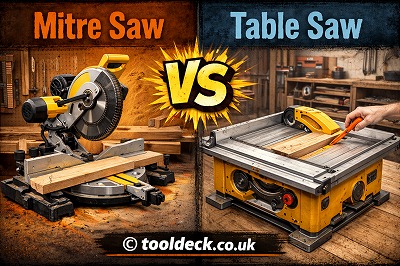
When it comes to woodworking, choosing the right tool can make all the difference. One of the most common comparisons DIYers and professionals face is mitre saw vs table saw. Both tools are essential in workshops across the UK, but they serve very different purposes.
In this guide, we’ll break down the differences, advantages, and best use cases so you can confidently decide which saw suits your needs.
What Is a Mitre Saw?
A mitre saw is a specialised tool designed for making accurate crosscuts and angled cuts. It features a mounted circular blade that swings down onto the material.
Key Features:
- Precise angle cuts (mitre and bevel)
- Ideal for trim work and framing
- Compact and portable
Best Uses:
- Cutting skirting boards
- Picture frames
- Door and window trims
- Angled cuts for moulding
Pros:
- Extremely accurate for angles
- Easy to use for beginners
- Portable and space-saving
Cons:
- Limited to shorter cuts
- Not suitable for ripping long boards
What Is a Table Saw?
A table saw is a powerful stationary tool where the blade protrudes through a flat table surface. You push the material through the blade to make cuts.
Key Features:
- Excellent for straight, long cuts
- Adjustable fence for precision
- High power for thicker materials
Best Uses:
- Ripping large sheets of wood
- Cutting plywood or MDF
- Furniture making
- Cabinet work
Pros:
- Ideal for long, straight cuts
- Handles large materials easily
- Highly versatile
Cons:
- Takes up more space
- Less portable
- Steeper learning curve
Mitre Saw vs Table Saw: Key Differences Explained in Detail
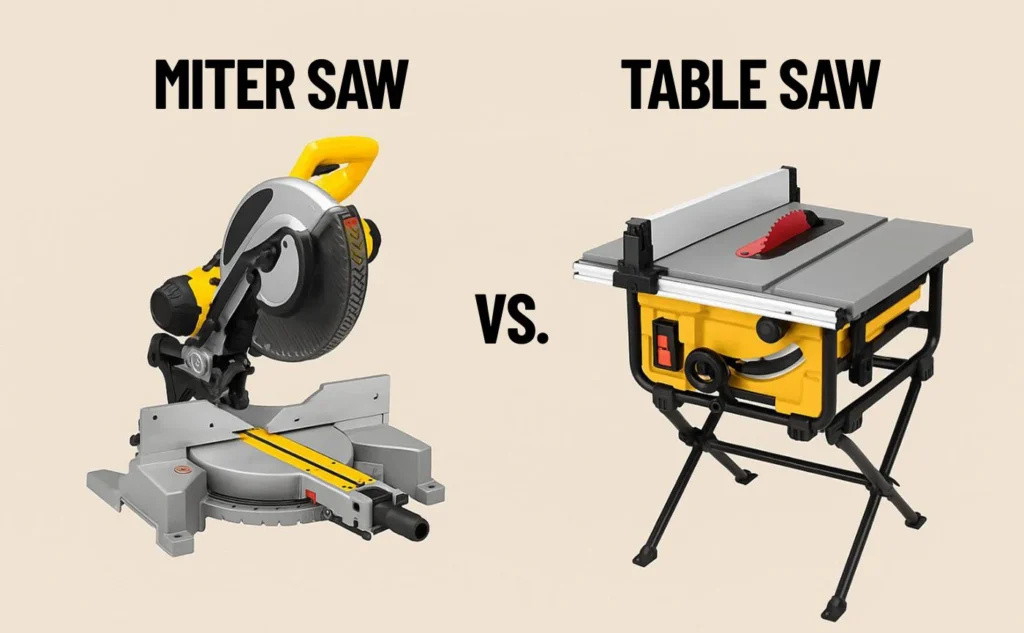
Understanding the differences between a mitre saw and a table saw is essential before investing in either tool. While both are designed to cut wood, they operate in completely different ways and are suited to distinct types of projects. Below is a detailed breakdown of the key differences to help UK users make an informed decision.
1. Cutting Function and Capabilities
The most fundamental difference between a mitre saw and a table saw lies in how they cut materials.
A mitre saw is designed primarily for crosscuts, meaning it cuts across the grain of the wood. It also excels at making angled cuts, including mitre (horizontal angle) and bevel (vertical angle) cuts. This makes it ideal for precision work where accuracy is critical.
In contrast, a table saw is built for rip cuts, which involve cutting along the length of the wood grain. It can also perform crosscuts with the help of accessories like a mitre gauge or crosscut sled, but this is not its main strength.
👉 Key takeaway:
- Choose a mitre saw for angles and finishing work
- Choose a table saw for long, straight cuts and breaking down large materials
2. Accuracy and Precision
Both tools offer high levels of accuracy, but in different contexts.
A mitre saw provides exceptional precision when cutting angles. The built-in angle guides and detents allow users to quickly set exact degrees (e.g. 45° or 90°), making it perfect for repeatable cuts in trim work or framing.
A table saw, on the other hand, delivers consistent accuracy over long cuts thanks to its fence system. Once properly aligned, it can produce identical rip cuts repeatedly, which is essential for furniture making and cabinetry.
👉 Key takeaway:
- Mitre saw = precision for angled cuts
- Table saw = consistency for straight, repeated cuts
3. Cutting Capacity and Material Size
Another major difference is the size of material each tool can handle.
A mitre saw is limited by its blade size and arm reach. While it can cut wider boards with sliding models, it is still not suitable for very large panels such as full sheets of plywood.
A table saw is far better suited for handling large and heavy materials, including MDF, plywood sheets, and long timber boards. The flat table surface provides support, making it easier to control bigger workpieces.
👉 Key takeaway:
- Mitre saw = smaller, more precise pieces
- Table saw = large boards and sheet materials
4. Portability and Setup
Portability is an important factor, especially for UK DIYers working in limited space or moving between job sites.
A mitre saw is generally compact and lightweight. Many models are designed to be portable, and some even come with folding stands, making them ideal for on-site work.
A table saw is usually heavier and more stationary. While portable table saws exist, they still require more setup and workspace compared to a mitre saw.
👉 Key takeaway:
- Mitre saw = portable and convenient
- Table saw = better for fixed workshop setups
5. Workspace Requirements
Your available workspace can significantly influence your decision.
A mitre saw can be used on a bench or small stand, making it suitable for garages or compact workshops commonly found in UK homes.
A table saw requires more room, not just for the machine itself but also for infeed and outfeed space to safely handle long materials.
👉 Key takeaway:
- Limited space → Mitre saw
- Dedicated workshop → Table saw
6. Versatility and Range of Applications
When it comes to versatility, the table saw generally has the upper hand.
A table saw can perform a wide range of cuts, including ripping, crosscutting, dado cuts (with the right blade setup), and even joinery work. It is often considered the core machine in a woodworking workshop.
A mitre saw is more specialised. While it excels at its intended tasks, it cannot replace the broader functionality of a table saw.
👉 Key takeaway:
- Table saw = highly versatile
- Mitre saw = specialised precision tool
7. Ease of Use and Learning Curve
For beginners, ease of use is a crucial consideration.
A mitre saw is straightforward to operate. You simply position the material, set the angle, and bring the blade down. This makes it very beginner-friendly.
A table saw requires more experience and understanding of techniques such as feed rate, fence alignment, and safety practices. Mistakes can lead to inaccurate cuts or safety risks.
👉 Key takeaway:
- Beginners → Mitre saw
- Experienced users → Table saw
8. Safety and Risk Factors
Both tools require careful handling, but the risks differ.
A mitre saw is generally considered safer because the blade is enclosed and moves downward in a controlled motion.
A table saw poses a higher risk, particularly due to kickback, where the material can be thrown back towards the user at high speed. Proper safety accessories and techniques are essential.
👉 Key takeaway:
- Mitre saw = lower risk
- Table saw = higher risk but manageable with proper safety measures
When comparing mitre saw vs table saw, it’s clear that neither tool is “better” overall—they simply serve different purposes.
- A mitre saw is perfect for precision, angles, and finishing work
- A table saw is ideal for power, versatility, and large-scale cutting
For many UK woodworkers, the best solution is eventually owning both tools to cover all types of projects.
Which One Should You Choose in the UK?
Choose a Mitre Saw if you:
- Work on trim, moulding, or framing
- Need precise angle cuts
- Have limited workspace
- Want a beginner-friendly tool
Choose a Table Saw if you:
- Cut large boards or sheet materials
- Build furniture or cabinets
- Need long, straight cuts
- Have a dedicated workshop
Can You Replace One with the Other?
Not really.
While both tools cut wood, they are designed for different tasks. Many UK woodworkers eventually invest in both tools for a complete workshop setup.
Mitre Saw vs Table Saw: Which Is Better for Beginners?
For beginners in the UK:
- A mitre saw is easier and safer to start with
- A table saw requires more skill and safety awareness
👉 If you’re just starting out, a mitre saw is usually the better first investment.
Safety Considerations
Both tools can be dangerous if used incorrectly.
Mitre Saw Safety Tips:
- Keep hands clear of the blade
- Clamp materials when possible
- Let the blade reach full speed before cutting
Table Saw Safety Tips:
- Use a push stick
- Never remove safety guards
- Stand to the side of the blade
- Avoid kickback by using a riving knife
FAQs
1. Is a table saw more powerful than a mitre saw?
Yes, table saws are generally more powerful and suitable for heavy-duty cutting.
2. Can a mitre saw rip wood?
No, mitre saws are not designed for ripping wood lengthwise.
3. Do I need both tools?
If you’re serious about woodworking, having both gives you maximum flexibility.
4. Which saw is best for DIY projects in the UK?
A mitre saw is usually better for general DIY tasks and home improvement.
Conclusion
When comparing mitre saw vs table saw, the right choice depends on your specific needs.
- Go for a mitre saw if you need precision and portability
- Choose a table saw for power and versatility
For most UK DIYers, starting with a mitre saw and upgrading later is a smart approach.



Leave a Reply