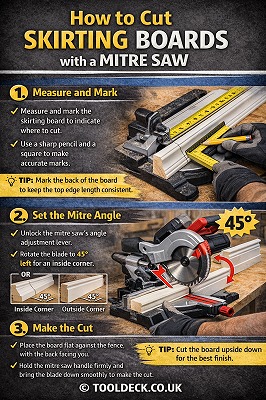
Cutting skirting boards neatly is one of the most satisfying upgrades you can make to a room—but it’s also where many DIYers go wrong. If you want clean corners and a professional finish, learning how to cut skirting boards with a mitre saw is essential.
In this UK-focused guide, you’ll learn step-by-step methods for internal and external corners, plus expert tips to get perfect joints every time.
What You Need Before You Start
To cut skirting boards accurately, you’ll need:
- Mitre saw (ideally 216mm or 255mm)
- Measuring tape
- Pencil
- Clamps (recommended)
- Coping saw (optional for internal corners)
- Safety gear (goggles, ear protection)
👉 Tip: MDF skirting is easier to cut, while hardwood requires a sharper blade.
Understanding Skirting Board Angles
There are two main types of cuts:
Internal Corners (Inside corners)
- Typically 90° wall corners
- Each piece is cut at 45° mitre
👉 Alternative method: coping (more precise for uneven walls)
External Corners (Outside corners)
- Corners that stick out
- Also cut at 45° angles
Step-by-Step: Cutting Internal Corners (Mitre Method)
Step 1: Measure the Wall
- Measure the length carefully
- Mark the cutting point clearly
Step 2: Set the Mitre Saw to 45°
- Rotate the saw to 45°
- Ensure it’s locked securely
Step 3: Position the Skirting Board
- Place it against the fence
- Keep the decorative face facing up
- Ensure correct orientation (this is critical)
Step 4: Make the Cut
- Cut slowly and steadily
- Repeat for the opposite side (mirrored angle)
Step 5: Test Fit
- Place both pieces in the corner
- Adjust if needed
Pro Method: Coping Internal Corners (Better Finish)
Mitre joints don’t always fit perfectly due to uneven UK walls.
👉 Professionals often use coping:
How it works:
- Cut one piece straight (90°)
- Cut the second piece at 45°
- Use a coping saw to follow the profile
✔ Result: tighter joints, better finish
Step-by-Step: Cutting External Corners
Step 1: Measure Carefully
External corners must be precise—no gaps allowed.
Step 2: Set Opposite 45° Angles
- First piece: 45° left
- Second piece: 45° right
Step 3: Cut and Align
- Ensure both cuts meet perfectly
- Sand lightly if needed
Common Mistakes to Avoid
❌ Cutting the Wrong Direction
Always visualise how pieces will meet before cutting.
❌ Incorrect Board Position
Skirting must sit exactly as it will on the wall.
❌ Not Accounting for Wall Angles
Walls are rarely perfect 90° in UK homes.
❌ Rushing the Job
Take your time—precision matters more than speed.
Tips for Perfect Skirting Cuts
✔ Use a Fine-Tooth Blade
Gives smoother, cleaner cuts—especially on MDF.
✔ Label Each Piece
Avoid confusion when installing multiple sections.
✔ Test on Scrap First
Prevents costly mistakes.
✔ Use Adhesive + Nails
Ensures a secure, long-lasting fit.
Specific Tips
- Older UK houses often have uneven walls → coping is better
- MDF skirting is most common in the UK market
- Use decorator’s caulk to fill small gaps
Mitre Saw Settings Cheat Sheet
| Cut Type | Angle Setting |
|---|---|
| Internal corner | 45° |
| External corner | 45° |
| Straight cut | 0° |
❓ FAQs
Do you cut skirting boards flat or upright on a mitre saw?
Most UK DIYers cut skirting boards flat against the base and fence. However, some professionals cut them upright to match wall positioning for better accuracy.
What angle do you cut skirting boards in the UK?
For standard corners, skirting boards are usually cut at 45 degrees. However, you may need to adjust slightly if walls are not perfectly square.
Is it better to cope or mitre skirting boards?
Coping is often better for internal corners, especially in older UK homes with uneven walls. It creates tighter joints and hides imperfections.
Why don’t my skirting board corners fit properly?
Common reasons include:
- Walls not being exactly 90°
- Incorrect angle settings
- Poor measurement or alignment
Can you cut skirting boards without a mitre saw?
Yes, you can use a mitre box and hand saw, but results are less precise compared to a mitre saw.
What is the best blade for cutting skirting boards?
A fine-tooth blade (60–80 teeth) is ideal for clean cuts, especially on MDF skirting boards commonly used in the UK.
Final Thoughts
Learning how to cut skirting boards with a mitre saw is a key skill for any UK DIYer. While mitre cuts work well, mastering coping will give you truly professional results—especially in older homes.
👉 Key takeaway:
- Measure carefully
- Set correct angles
- Always test before final cuts
With the right approach, your skirting boards will look clean, tight, and professionally installed.



Leave a Reply