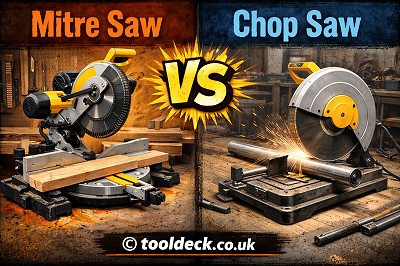
Choosing between a mitre saw vs chop saw depends on one key factor: material and purpose. A mitre saw is built for precision woodworking, while a chop saw is designed for powerful metal cutting.
This guide breaks down the real differences to help you choose the right tool for your job.
⚙️ What Is a Mitre Saw?
A mitre saw is a stationary cutting tool designed for making precise crosscuts and angled cuts in wood.
Key features:
- Fixed base with pivoting blade
- Accurate mitre and bevel cuts
- Clean, repeatable results
👉 Best for precision woodworking and finishing tasks.
🔧 What Is a Chop Saw?
A chop saw is a powerful cut-off saw designed mainly for cutting metal using an abrasive disc.
Key features:
- High-speed abrasive blade
- Designed for steel and metal
- Produces sparks and heat
👉 Ideal for metalwork, construction, and fabrication.
Mitre Saw vs Chop Saw – Key Differences
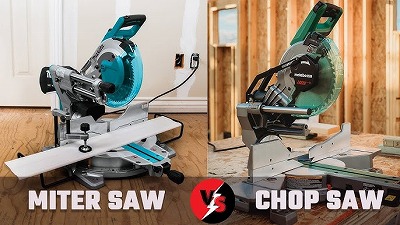
Understanding the real differences between a mitre saw vs chop saw is essential before choosing the right tool. While they may look similar, they are built for completely different tasks, materials, and working environments.
Let’s break down each difference in detail 👇
🔹 1. Material Compatibility (Most Important Difference)
🔧 Mitre Saw:
A mitre saw is designed primarily for:
- Softwood and hardwood
- MDF and plywood
- Plastic trims
It uses a toothed blade that slices cleanly through wood fibres without burning or tearing.
🔌 Chop Saw:
A chop saw is built for:
- Steel bars and pipes
- Rebar and structural metal
- Aluminium (with correct disc)
It uses an abrasive disc that grinds through metal, generating sparks and heat.
👉 Key takeaway:
Using the wrong tool is not just ineffective — it can be dangerous.
🔹 2. Cutting Precision & Finish Quality
🔧 Mitre Saw:
Mitre saws deliver:
- Razor-sharp edges
- Clean finish (minimal sanding needed)
- Perfect alignment for joints
This makes them ideal for:
- Skirting boards
- Architraves
- Furniture
🔌 Chop Saw:
Chop saw cuts typically result in:
- Rough edges
- Burrs on metal
- Heat discoloration
You’ll often need:
- Grinding
- Filing
- Deburring
👉 Verdict:
- Clean finish → Mitre saw
- Functional cut → Chop saw
🔹 3. Blade Type & Cutting Mechanism
🔧 Mitre Saw:
- Uses carbide-tipped teeth
- Cuts by slicing material
- Produces minimal heat
🔌 Chop Saw:
- Uses abrasive disc
- Cuts by grinding
- Generates high heat and sparks
👉 This explains why:
- Mitre saw = precision
- Chop saw = brute force
🔹 4. Sparks, Heat & Work Environment
🔧 Mitre Saw:
- Produces sawdust
- Low heat generation
- Safe for indoor use
🔌 Chop Saw:
- Produces sparks
- High temperatures
- Requires PPE and fire safety
👉 Important for UK users:
Chop saws should be used in well-ventilated areas, away from flammable materials.
🔹 5. Cutting Angles & Flexibility
🔧 Mitre Saw:
Offers:
- Mitre angles (left/right)
- Bevel cuts
- Compound cuts
Perfect for:
- Corners
- Frames
- Trim work
🔌 Chop Saw:
Typically limited to:
- Straight 90° cuts
- Basic angle adjustment (on some models)
👉 Verdict:
- Versatility → Mitre saw
- Simplicity → Chop saw
🔹 6. Power vs Precision (Core Difference)
🔧 Mitre Saw:
- Designed for accuracy and control
- Smooth, consistent cuts
- Lower torque
🔌 Chop Saw:
- Designed for raw cutting power
- High torque motor
- Cuts dense materials easily
👉 Simple way to remember:
- Mitre saw = fine carpentry tool
- Chop saw = industrial cutting tool
🔹 7. Safety & User Experience
🔧 Mitre Saw:
- Safer for beginners
- Controlled cutting motion
- Lower risk environment
🔌 Chop Saw:
- Higher risk due to sparks
- Requires PPE
- Louder and more aggressive
👉 Verdict:
Mitre saw is more beginner-friendly.
🔹 8. Typical Use Cases in the UK
🔧 Mitre Saw:
Used by:
- Carpenters
- Joiners
- DIY homeowners
🔌 Chop Saw:
Used by:
- Metal fabricators
- Builders
- Mechanics
🧠 Final Comparison Insight
The difference between mitre saw vs chop saw comes down to one simple principle:
👉 Precision vs Power
- Choose mitre saw for clean, accurate woodworking
- Choose chop saw for fast, heavy-duty metal cutting
📊 Quick Comparison Table
| Feature | Mitre Saw | Chop Saw |
|---|---|---|
| Material | Wood | Metal |
| Precision | ⭐⭐⭐⭐⭐ | ⭐⭐ |
| Power | ⭐⭐⭐ | ⭐⭐⭐⭐⭐ |
| Sparks | ❌ | ✅ |
| Angle Cuts | ✅ | Limited |
| Finish Quality | Excellent | Rough |
When to Choose a Mitre Saw
Choose a mitre saw if you:
- Work with wood
- Need accurate angle cuts
- Do trim or finishing work
- Want clean results
👉 Best for carpentry and DIY.
When to Choose a Chop Saw
Choose a chop saw if you:
- Work with metal
- Need cutting power
- Do fabrication or construction
- Cut steel regularly
👉 Best for metalworking tasks.
❌ Common Mistakes to Avoid
❌ Using mitre saw for metal
✔ Use chop saw instead
❌ Expecting clean finish from chop saw
✔ Use grinder to smooth edges
❓ FAQs
Which is better for beginners?
Mitre saw (for wood projects).
Can a chop saw cut wood?
Not recommended.
Which tool is safer?
Mitre saw.
Do I need both tools?
If you work with both wood and metal → yes.
🏁 Final Thoughts
When comparing mitre saw vs chop saw, the difference is simple: precision vs power.
- Choose a mitre saw for clean, accurate woodworking
- Choose a chop saw for heavy-duty metal cutting


Leave a Reply