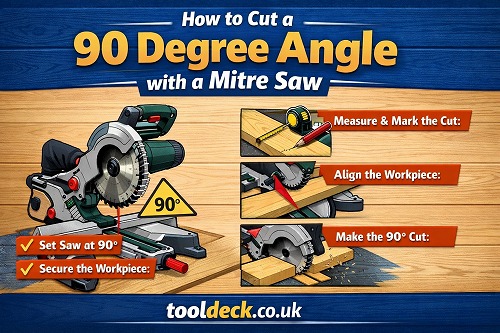
Cutting a perfect 90 degree angle is one of the most fundamental tasks in woodworking. Whether you’re framing, installing skirting boards, or making furniture, knowing how to cut a 90 degree angle with a mitre saw ensures straight, accurate results every time.
In this UK-focused guide, you’ll learn the exact steps, setup, and pro tips to achieve clean and precise 90° cuts.
What Is a 90 Degree Cut?
A 90° cut is a straight crosscut, where the blade cuts perpendicular to the material.
👉 Common UK uses:
- Cutting timber to length
- Framing and construction
- Skirting boards (straight runs)
- Flooring and decking
Tools You’ll Need
Before you start:
- Mitre saw (any standard model)
- Measuring tape
- Pencil
- Clamp (recommended)
- Safety gear (goggles, ear protection)
Step-by-Step: How to Cut a 90 Degree Angle
Step 1: Measure and Mark
- Measure your material accurately
- Mark the cut line clearly
💡 Tip: Always mark the waste side.
Step 2: Set the Mitre Saw to 0°
- Unlock the mitre adjustment
- Set the angle to 0° (straight cut)
- Lock it securely
👉 0° = 90° cut relative to the material.
Step 3: Position the Material
- Place the material flat on the base
- Push it firmly against the fence
- Align the blade with your mark
Step 4: Secure the Material
- Use a clamp if possible
- Ensure no movement during cutting
Step 5: Make the Cut
- Start the saw and let it reach full speed
- Lower the blade slowly
- Do NOT force the cut
Step 6: Finish Safely
- Wait for the blade to stop
- Lift the saw
- Remove the material
How to Check If Your Cut Is Perfect
- Use a square to check the edge
- Join two pieces to test alignment
👉 If there are gaps, your saw may need calibration.
Common Uses for 90° Cuts
Straight Timber Cuts
- Cutting wood to size
Framing
- Creating square structures
Flooring
- Cutting boards to length
Joinery Prep
- Preparing pieces before angled cuts
Tips for Perfect 90° Cuts
✔ Keep the Fence Clean
Dust can affect alignment.
✔ Use a Sharp Blade
Improves cut quality and accuracy.
✔ Calibrate Your Saw
Ensures true 90° cuts every time.
✔ Use Stop Blocks
Perfect for repeat cuts.
Common Mistakes to Avoid
❌ Not Setting the Angle Properly
Even slight misalignment affects accuracy.
❌ Loose Material
Movement leads to uneven cuts.
❌ Rushing the Cut
Always cut slowly and steadily.
❌ Ignoring Calibration
An uncalibrated saw won’t cut true 90°.
UK-Specific Tips
- Timber sizes in the UK may vary slightly—always measure
- Use fine-tooth blades for MDF and laminate
- Check your saw regularly if used on-site
Quick Cheat Sheet
| Cut Type | Mitre Setting |
|---|---|
| 90° cut | 0° |
| 45° cut | 45° |
| Bevel cut | Adjust tilt |
❓ FAQs: Cutting a 90 Degree Angle
What setting is a 90 degree cut on a mitre saw?
A 90° cut is made by setting the mitre saw to 0°, which creates a straight crosscut.
Why is my 90 degree cut not straight?
This is usually due to a misaligned fence, incorrect setup, or the saw needing calibration.
How do I check if my cut is 90 degrees?
Use a square to check the cut edge or join two pieces together to see if they form a perfect right angle.
Can I cut a 90 degree angle without a mitre saw?
Yes, using a hand saw and square or a mitre box, but accuracy is lower compared to a mitre saw.
Do I need to adjust the bevel for a 90 degree cut?
No, the bevel should remain at 0°. Only the mitre setting is used for standard 90° cuts.
What is a 90 degree cut used for?
It’s used for straight cuts in framing, construction, flooring, and general woodworking.
Final Thoughts
Learning how to cut a 90 degree angle with a mitre saw is a basic but essential skill. With the right setup and attention to detail, you can achieve perfectly straight cuts for any project.
👉 Key takeaway:
- Set saw to 0°
- Secure your material
- Check accuracy with a square




Leave a Reply