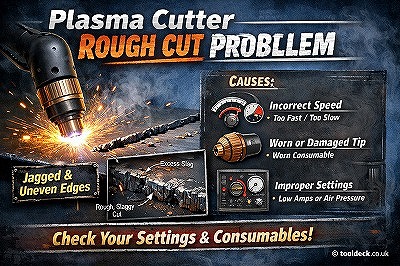
If your plasma cutter is producing rough, uneven cuts, it can ruin the finish of your work and require extra grinding or rework. This is one of the most common issues faced by both beginners and experienced users in the UK.
A rough cut typically means something is wrong with your settings, consumables, airflow, or technique.
In this complete guide, you’ll learn:
- What causes rough plasma cuts
- Step-by-step fixes
- How to achieve clean, professional results
- Pro tips to improve cutting quality
⚠️ Signs of a Rough Plasma Cut
Before troubleshooting, confirm these symptoms:
- ❌ Jagged or uneven edges
- ❌ Excessive slag (dross)
- ❌ Wide or inconsistent kerf
- ❌ Burn marks or discoloration
- ❌ Poor cut precision
👉 These indicate poor arc stability or incorrect cutting conditions.
Plasma Cutter Rough Cut Problem – Common Causes & Fixes
🔹 1. Incorrect Amperage (Too High or Too Low)
❌ Why It Happens:
- Amperage too low → arc lacks power to fully penetrate
- Amperage too high → excessive heat widens the kerf and melts edges
🔍 Symptoms:
- Low amps:
- Incomplete cuts
- Rough bottom edge
- High amps:
- Wide, messy cuts
- Heavy dross formation
✅ Fix:
- Match amperage to material thickness:
- Thin metal → lower amps
- Thick metal → higher amps
- Use manufacturer cutting charts
👉 Pro Tip: Correct amperage gives a narrow, focused arc and cleaner edge.
🔹 2. Worn or Damaged Consumables
❌ Why It Happens:
- Nozzle orifice becomes enlarged
- Electrode develops pits
- Arc loses focus and stability
🔍 Symptoms:
- Jagged, inconsistent cut edge
- Arc wanders or spreads
- Reduced cut precision
✅ Fix:
- Inspect:
- Nozzle opening (should be perfectly round)
- Electrode tip (no deep pitting)
- Replace consumables regularly
- Always replace as a set if heavily worn
👉 Pro Tip: A worn nozzle is one of the biggest causes of rough cuts.
🔹 3. Incorrect Cutting Speed
❌ Why It Happens:
- Moving too fast → arc cannot fully cut through
- Moving too slow → excessive heat and dross
🔍 Symptoms:
- Too fast:
- Rough bottom edge
- Incomplete cut
- Too slow:
- Heavy slag buildup
- Burn marks
✅ Fix:
- Adjust speed based on material thickness
- Watch sparks:
- Straight downward = correct speed
- Backwards = too fast
👉 Pro Tip: Spark direction is the easiest way to judge speed.
🔹 4. Incorrect Torch Height (Standoff Distance)
❌ Why It Happens:
- Torch held too far → weak arc
- Torch too close → turbulence and damage
🔍 Symptoms:
- Wide, uneven cuts
- Poor edge quality
- Inconsistent arc
✅ Fix:
- Maintain correct distance:
- Typically 2–4 mm from surface
- Use drag shield or guide if available
👉 Pro Tip: Even small height variations can ruin cut quality.
🔹 5. Poor Air Pressure or Inconsistent Airflow
❌ Why It Happens:
- Low pressure → weak arc
- High pressure → unstable arc
- Compressor cannot maintain airflow
🔍 Symptoms:
- Rough edges
- Inconsistent cutting
- Excessive slag
✅ Fix:
- Set pressure correctly (60–90 PSI under load)
- Ensure compressor provides enough CFM
- Check for leaks and restrictions
👉 Pro Tip: Airflow affects both arc strength and molten metal removal.
🔹 6. Moisture or Contaminated Air
❌ Why It Happens:
- Water in compressed air
- Oil or dirt contamination
- Lack of air filtration
🔍 Symptoms:
- Irregular plasma stream
- Rough, inconsistent cuts
- Short consumable life
✅ Fix:
- Install:
- Moisture separator
- Air dryer
- Drain compressor tank daily
👉 Pro Tip: Clean, dry air is essential for smooth cuts.
🔹 7. Poor Ground Connection
❌ Why It Happens:
- Clamp attached to painted or rusty surface
- Loose connection
🔍 Symptoms:
- Arc instability
- Rough or inconsistent cuts
- Intermittent arc
✅ Fix:
- Attach clamp to clean, bare metal
- Ensure tight connection
- Grind surface if needed
👉 Pro Tip: A weak ground reduces arc stability significantly.
🔹 8. Incorrect Torch Angle
❌ Why It Happens:
- Torch tilted during cutting
- Inconsistent hand movement
🔍 Symptoms:
- Bevelled or uneven edges
- One side smoother than the other
✅ Fix:
- Keep torch at 90° to material
- Maintain consistent angle throughout cut
👉 Pro Tip: Angle affects edge symmetry and finish quality.
🔹 9. Low-Quality or Incorrect Consumables
❌ Why It Happens:
- Cheap consumables with poor tolerances
- Incorrect type for material
🔍 Symptoms:
- Poor arc focus
- Rough and inconsistent cuts
✅ Fix:
- Use high-quality, compatible consumables
- Follow manufacturer recommendations
👉 Pro Tip: Cheap parts often cost more in the long run.
🔹 10. Power Supply Instability
❌ Why It Happens:
- Voltage drop from extension leads
- Shared circuits
- Weak power source
🔍 Symptoms:
- Weak arc
- Inconsistent cutting performance
- Rough edges
✅ Fix:
- Use stable UK 230V mains supply
- Avoid long or thin extension leads
- Use dedicated circuit if possible
👉 Pro Tip: Power issues can mimic other cutting problems.
Step-by-Step Quick Fix Checklist
- ✅ Adjust amperage
- ✅ Replace consumables
- ✅ Check air pressure
- ✅ Improve grounding
- ✅ Maintain torch height
- ✅ Control cutting speed
👉 These steps fix most rough cut issues.
Pro Tips for Cleaner Plasma Cuts
- Use high-quality consumables
- Keep air dry and clean
- Maintain steady hand movement
- Practice on scrap material
- Keep equipment well maintained
❌ Common Mistakes to Avoid
❌ Using worn consumables
✔ Replace regularly
❌ Incorrect speed
✔ Adjust based on thickness
❌ Poor setup
✔ Check settings carefully
Safety Tips
- Wear proper PPE
- Ensure ventilation
- Avoid overheating
FAQs
Why are my plasma cuts rough?
Usually due to incorrect settings or worn consumables.
How do I get smooth cuts?
Adjust speed, amperage, and replace consumables.
Does air pressure affect cut quality?
Yes — significantly.
Should I grind after cutting?
Only if necessary.
Final Thoughts
If you’re experiencing a plasma cutter rough cut problem, the issue is usually caused by incorrect settings, worn consumables, or airflow issues. By following this guide, you can achieve clean, precise cuts with minimal effort.




Leave a Reply