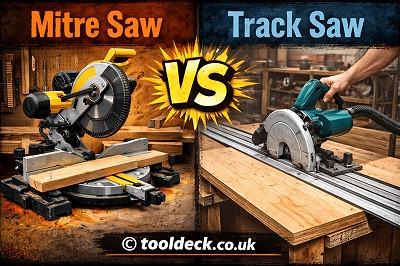
When choosing between a mitre saw vs track saw, many UK DIYers and professionals struggle to decide which tool is right for their projects. While both are designed for cutting wood with precision, they serve very different purposes.
We’ll break down the differences, pros and cons, real-world use cases, and help you choose the best tool for your needs.
What Is a Mitre Saw?
A mitre saw is a stationary power tool designed for making precise crosscuts and angled cuts. The blade is mounted on a pivoting arm, allowing you to cut mitres and bevels with high accuracy.
Common Uses:
- Cutting skirting boards and architraves
- Trim and finish carpentry
- Framing timber
- Repeatable angle cuts
👉 Best for: Quick, accurate angle cuts
What Is a Track Saw?
A track saw (also known as a plunge saw) is a handheld circular saw that runs along a guide rail (track). It allows you to make long, straight, and highly accurate cuts—especially on large sheets.
Common Uses:
- Cutting sheet materials (plywood, MDF)
- Breaking down large boards
- Cabinet making
- Straight rip cuts
👉 Best for: Long, straight precision cuts
Mitre Saw vs Track Saw: Key Differences
| Feature | Mitre Saw | Track Saw |
|---|---|---|
| Tool Type | Stationary | Handheld with guide rail |
| Best Cuts | Crosscuts & angles | Long straight cuts (rip cuts) |
| Portability | Medium | High |
| Precision | Excellent (angles) | Excellent (straight lines) |
| Material Size | Limited by blade width | Ideal for large sheets |
| Setup | Quick | Requires track setup |
Mitre Saw: Pros & Cons
✅ Advantages
- Extremely accurate angle cuts
- Fast and efficient for repeat jobs
- Easy to use for beginners
- Ideal for trim work
❌ Disadvantages
- Limited cutting width
- Not suitable for large panels
- Less portable than track saws
👉 Best for:
- Skirting boards
- Framing
- DIY home projects
- Joinery work
Track Saw: Pros & Cons
✅ Advantages
- Perfect for large materials
- Cleaner cuts with minimal tear-out
- Highly portable
- Great alternative to table saws
❌ Disadvantages
- Slower setup time
- Less efficient for repeated cuts
- Not ideal for angle cuts
👉 Best for:
- Sheet materials
- Cabinet making
- Furniture building
- On-site cutting
Use Cases
🏠 DIY Homeowner
If you’re installing flooring, trims, or doing light renovation work, a mitre saw is usually the better choice.
🪚 Furniture Maker / Cabinet Maker
If you frequently cut plywood or MDF sheets, a track saw is far more practical and precise.
🔨 Tradesperson
Many professionals in the UK use both tools together:
- Mitre saw → angles and trims
- Track saw → sheet cutting
👉 This combination covers nearly all cutting needs.
Which One Should You Choose?
Choose a Mitre Saw if:
- You need angle cuts
- You do trim or framing work
- You want speed and repeatability
- You’re a beginner
Choose a Track Saw if:
- You cut large boards or panels
- You need straight, splinter-free cuts
- You want portability
- You don’t have space for a table saw
Buying Tip (Important)
Many beginners in the UK buy the wrong tool because they focus on price instead of use case.
👉 Ask yourself:
- Cutting angles? → Mitre saw
- Cutting large boards? → Track saw
Price Comparison
- Mitre Saw: £80 – £400+
- Track Saw (with rail): £150 – £600+
Popular UK brands:
- Makita
- Bosch
- DeWalt
- Evolution
Final Verdict: Mitre Saw vs Track Saw
These tools are not competitors—they are complementary.
- Mitre Saw = Best for angle cuts and speed
- Track Saw = Best for straight cuts and large materials
👉 If your budget allows, owning both gives you maximum flexibility.



Leave a Reply