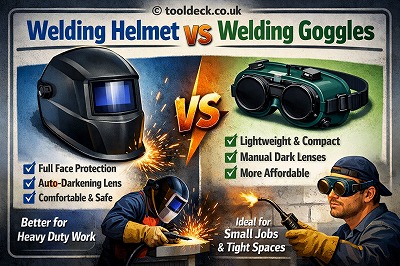
When it comes to welding safety, one of the most common questions beginners and even experienced welders ask is: should you use a welding helmet or welding goggles?
Both options are designed to protect your eyes from the intense light produced during welding. However, they differ significantly in terms of protection level, usability, and suitability for different tasks.
Choosing the wrong type of protection can lead to poor weld quality, discomfort, or even serious eye injuries.
In this complete UK guide, we’ll cover:
- What welding helmets and goggles are
- Key differences in protection and performance
- Pros and cons of each
- When to use each option
- Expert recommendations for UK welders
⚠️ Why Proper Welding Eye Protection Is Essential
Welding produces extremely intense light, including:
- Ultraviolet (UV) radiation
- Infrared (IR) radiation
- Bright visible light
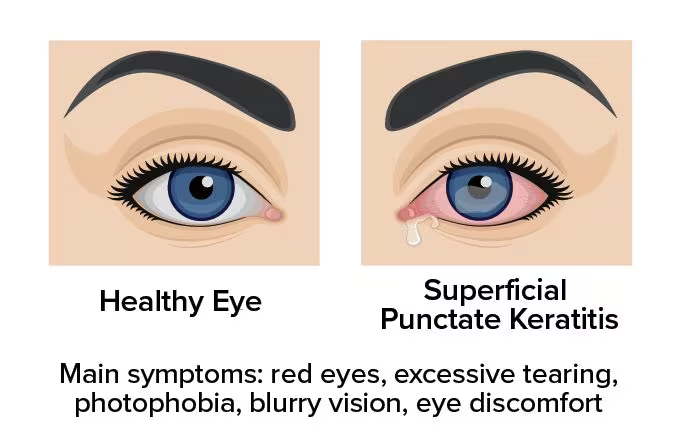
🔥 Without proper protection, you risk:
- Arc eye (welder’s flash)
- Severe eye irritation (burning sensation)
- Temporary or permanent vision damage
👉 This is why choosing between a helmet and goggles is not just about comfort — it’s about safety.
🔍 What Is a Welding Helmet?
A welding helmet is a full-face protective device designed to shield not only your eyes but also your face and part of your neck from welding hazards.
🔹 Types of Welding Helmets:
1. Auto-Darkening Helmets
- Automatically adjust shade when arc is struck
- Most common in modern UK workshops
2. Passive Helmets (Fixed Shade)
- Always dark
- Require manual positioning
🔹 Key Features:
- Large viewing window
- Adjustable shade levels (typically 9–13)
- Arc sensors (for auto-darkening models)
- Full protection against sparks and spatter
👉 Welding helmets are considered the standard choice for most welding applications.
🔍 What Are Welding Goggles?
Welding goggles are compact eye protection devices that cover only the eyes, leaving the rest of the face exposed.
🔹 Types of Welding Goggles:
- Fixed shade goggles
- Flip-up lens goggles
🔹 Key Features:
- Lightweight and portable
- Simple design
- Limited protection area
👉 Welding goggles are typically used for light-duty or specialised tasks, not full-scale welding.
⚖️ Welding Helmet vs Welding Goggles – Detailed Comparison
| Feature | Welding Helmet | Welding Goggles |
|---|---|---|
| Coverage | Full face | Eyes only |
| Protection Level | High | Moderate |
| Safety | Excellent | Limited |
| Comfort | Heavier | Lightweight |
| Visibility | Wide view | Narrow view |
| Cost | Higher | Lower |
👉 The biggest difference lies in protection and usability.
✅ Advantages of Welding Helmets
🛡️ 1. Full Face and Eye Protection
A welding helmet protects:
- Eyes
- Face
- Skin from sparks and UV
👉 This significantly reduces the risk of burns and injuries.
👁️ 2. Superior Visibility
Modern helmets offer:
- Wide viewing area
- Clear pre-weld visibility
- Auto-darkening convenience
👉 This improves weld accuracy and efficiency.
⚙️ 3. Hands-Free Operation
Unlike goggles, helmets:
- Stay in place
- Don’t require manual adjustment
👉 Ideal for longer welding sessions.
🔧 4. Adjustable Settings
Auto-darkening helmets allow you to adjust:
- Shade level
- Sensitivity
- Delay
👉 This makes them suitable for different welding processes.
❌ Disadvantages of Welding Helmets
- Heavier than goggles
- More expensive
- Can feel bulky in tight spaces
👉 However, these are minor compared to the safety benefits.
✅ Advantages of Welding Goggles
🎯 1. Lightweight and Comfortable
Goggles are:
- Easy to wear
- Less strain on neck
👉 Suitable for short jobs.
💷 2. More Affordable
- Lower upfront cost
- Good for occasional use
🔍 3. Better in Tight Spaces
Because of their compact size:
- Easier to use in confined areas
👉 Useful for specific applications.
❌ Disadvantages of Welding Goggles
⚠️ 1. Limited Protection
Goggles do NOT protect:
- Face
- Skin from sparks
👉 This increases injury risk.
⚠️ 2. Reduced Safety
- Exposure to flying debris
- Higher chance of burns
⚠️ 3. Less Suitable for Long Use
- Can cause eye fatigue
- Limited visibility
👉 Not ideal for professional welding.
🛠️ When Should You Use a Welding Helmet?
Use a welding helmet for:
- MIG welding
- TIG welding
- Stick welding
- Long welding sessions
- Professional or workshop use
👉 In the UK, helmets are the recommended standard for most welders.
🛠️ When Are Welding Goggles Suitable?
Use welding goggles for:
- Brazing and soldering
- Oxy-acetylene cutting
- Quick repair jobs
- Light-duty work
👉 Not suitable for heavy arc welding.
⚠️ Safety Comparison – Helmet vs Goggles
Welding Helmet:
✔ Full protection
✔ Safer for all welding types
✔ Protects against sparks and UV
Welding Goggles:
✔ Eye protection only
❌ No facial protection
❌ Higher injury risk
👉 Helmets provide significantly better overall safety.
🧠 Expert Tips for Welders
- Always prioritise safety over cost
- Use helmets for any serious welding
- Keep lenses clean for clear visibility
- Replace damaged lenses immediately
- Store equipment in dry conditions (important in UK climate)
❌ Common Mistakes to Avoid
❌ Using goggles for heavy welding
✔ Always use a helmet
❌ Ignoring face protection
✔ Sparks can cause burns
❌ Choosing cheapest option
✔ Quality matters
🛡️ UK Safety Standards to Look For
When buying welding protection, check for:
- EN379 (auto-darkening helmets)
- EN166 (eye protection)
- CE certification
👉 Ensures proper safety compliance in the UK.
❓ FAQs
Are welding goggles safe for all welding?
No — only for light-duty tasks.
Can beginners use goggles instead of helmets?
Not recommended — helmets are safer and easier to use.
Are auto-darkening helmets better?
Yes — they improve visibility and convenience.
Which option is best for professionals?
Welding helmet, without question.
🏁 Final Verdict – Which Is Better?
🥇 Best Overall: Welding Helmet
✔ Maximum protection
✔ Better visibility
✔ Suitable for all welding types
🥈 Best for Light Work: Welding Goggles
✔ Lightweight
✔ Affordable
✔ Limited applications
👉 For most UK welders, a welding helmet is the safest and most practical choice.




Leave a Reply