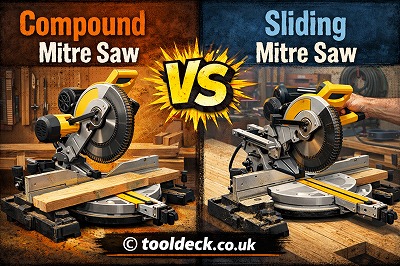
When choosing a mitre saw in the UK, one of the most important decisions you’ll face is whether to go for a sliding mitre saw or a non-sliding (standard) mitre saw. While both tools are designed for making precise angled cuts, they differ significantly in capacity, versatility, and price.
We’ll break down the key differences, pros and cons, and help you decide which option is best suited to your needs.
What Is a Sliding Mitre Saw?
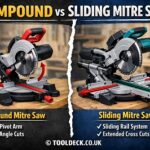
A sliding mitre saw is equipped with rails that allow the blade to move forward and backwards during a cut. This sliding action increases the cutting capacity, making it ideal for working with wider materials.
Key Features
- Sliding rails for extended reach
- Larger cutting width
- Suitable for wider timber boards
- Often includes bevel and compound cutting capabilities
Typical Uses
- Cutting wide floorboards and decking
- Trimming large pieces of timber
- Professional carpentry and joinery work
What Is a Non-Sliding Mitre Saw?
A non-sliding mitre saw (also known as a chop saw) has a fixed blade that moves only up and down. It’s more compact and typically used for smaller, more precise cuts.
Key Features
- Fixed cutting head
- Compact and lightweight
- Easier to transport
- Lower cost compared to sliding models
Typical Uses
- Cutting skirting boards and mouldings
- Small DIY projects
- Light woodworking tasks
Sliding vs Non-Sliding Mitre Saw: Key Differences
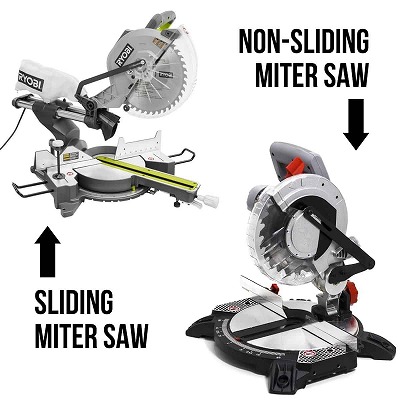
Understanding the difference between a sliding and a non-sliding mitre saw is essential before making a purchase. While both tools are designed for accurate crosscuts and angled cuts, they perform very differently in real-world use.
Below is a detailed breakdown of the most important differences that UK buyers should consider.
1. Cutting Capacity (Width & Depth)
The biggest and most noticeable difference between these two types of mitre saws is cutting capacity.
Sliding Mitre Saw
A sliding mitre saw uses rails that allow the blade to move forward and backwards. This dramatically increases the width of material you can cut in a single pass.
- Can cut wide boards (often 250mm–350mm depending on blade size)
- Ideal for large timber, flooring, decking, and worktops
- Reduces the need to flip material mid-cut
Non-Sliding Mitre Saw
A non-sliding mitre saw has a fixed cutting motion (up and down only), which limits how wide the cut can be.
- Typically handles narrower materials (100mm–150mm)
- Best for trim, mouldings, and smaller timber
- May require flipping wider boards to complete cuts
👉 Verdict: If you work with wide materials, a sliding mitre saw is significantly more efficient.
2. Accuracy and Stability
Precision is critical in woodworking, especially for finish carpentry.
Sliding Mitre Saw
Because of the rail mechanism, there is slightly more movement involved.
- Requires proper setup and calibration
- Bearings and rails can introduce minor play over time
- High-end models minimise this issue
Non-Sliding Mitre Saw
With fewer moving parts, these saws tend to be more rigid.
- Naturally stable design
- Consistent cutting angle
- Preferred for fine detail work
👉 Verdict: For ultra-precise cuts (e.g. skirting boards or coving), non-sliding saws often have the edge.
3. Space Requirements
Workspace size is a major factor, especially in UK homes and garages where space is limited.
Sliding Mitre Saw
- Requires extra clearance behind the saw for rails
- Larger footprint overall
- Not ideal for tight workspaces
Non-Sliding Mitre Saw
- Compact design
- Can be placed against a wall
- Easy to store or mount on smaller benches
👉 Verdict: If space is limited, a non-sliding mitre saw is the more practical choice.
4. Portability and Weight
If you need to move your tool between job sites, portability becomes important.
Sliding Mitre Saw
- Heavier due to rails and larger frame
- Less convenient to transport
- Often used as a fixed workshop tool
Non-Sliding Mitre Saw
- Lightweight and compact
- Easy to carry and transport
- Ideal for mobile tradespeople and DIY users
👉 Verdict: Non-sliding saws are much easier to move and transport.
5. Price and Budget Considerations
Budget is always a key deciding factor for UK buyers.
Sliding Mitre Saw
- Higher price due to added functionality
- Better long-term investment for frequent use
- More features (dual bevel, laser guides, etc.)
Non-Sliding Mitre Saw
- More affordable
- Great for beginners or occasional use
- Lower upfront cost
👉 Verdict: If you’re on a budget, a non-sliding mitre saw offers excellent value.
6. Versatility and Applications
Different projects require different levels of flexibility.
Sliding Mitre Saw
- Handles a wider variety of materials and sizes
- Suitable for structural and finishing work
- Better for professional carpenters
Non-Sliding Mitre Saw
- Best for repetitive, smaller cuts
- Ideal for trim work and DIY tasks
- Limited when working with large timber
👉 Verdict: Sliding mitre saws are more versatile overall.
7. Ease of Use
Sliding Mitre Saw
- Slight learning curve
- More adjustments and moving parts
- Requires proper technique for best results
Non-Sliding Mitre Saw
- Simple operation
- Beginner-friendly
- Minimal setup required
👉 Verdict: Non-sliding saws are easier for beginners to use confidently.
Choosing between a sliding and non-sliding mitre saw comes down to your specific needs, workspace, and budget.
- Go for a sliding mitre saw if you need power, flexibility, and larger cutting capacity
- Choose a non-sliding mitre saw if you value simplicity, portability, and affordability
For many UK DIY users, a non-sliding saw is more than enough. However, for larger or more advanced projects, a sliding model can make a significant difference in efficiency and results.
Sliding Mitre Saw
Pros
- Cuts wider materials
- More versatile
- Ideal for professional use
Cons
- Higher cost
- Requires more space
- Slightly more complex to use
Non-Sliding Mitre Saw
Pros
- Affordable
- Compact and portable
- Simple to use
Cons
- Limited cutting width
- Less versatile
Which One Is Best for You?
Choose a Sliding Mitre Saw if:
- You regularly cut wide boards or timber
- You’re a professional or serious DIYer
- You need maximum versatility
Choose a Non-Sliding Mitre Saw if:
- You mainly work with smaller materials
- You have limited space
- You’re a beginner or occasional DIY user
FAQs
Is a sliding mitre saw worth it for DIY?
Yes, if you frequently work with wide materials. Otherwise, a non-sliding saw is usually sufficient for basic DIY tasks.
Do sliding mitre saws take up more space?
Yes, they require additional clearance behind the saw for the sliding rails.
Are non-sliding mitre saws accurate enough?
Absolutely. They are often preferred for precision cuts in smaller materials.
Final Verdict
Both sliding and non-sliding mitre saws have their place in a UK workshop. The right choice ultimately depends on your project needs, budget, and available space.
- For power, flexibility, and larger cuts → go with a sliding mitre saw
- For simplicity, portability, and cost-effectiveness → a non-sliding mitre saw is ideal
If you’re just getting started, a non-sliding model may be all you need. However, if you plan to take on bigger projects in the future, investing in a sliding mitre saw could save you time and effort in the long run.

Leave a Reply